Compression Stockings for Varicose Veins: Types, Uses & How They Work
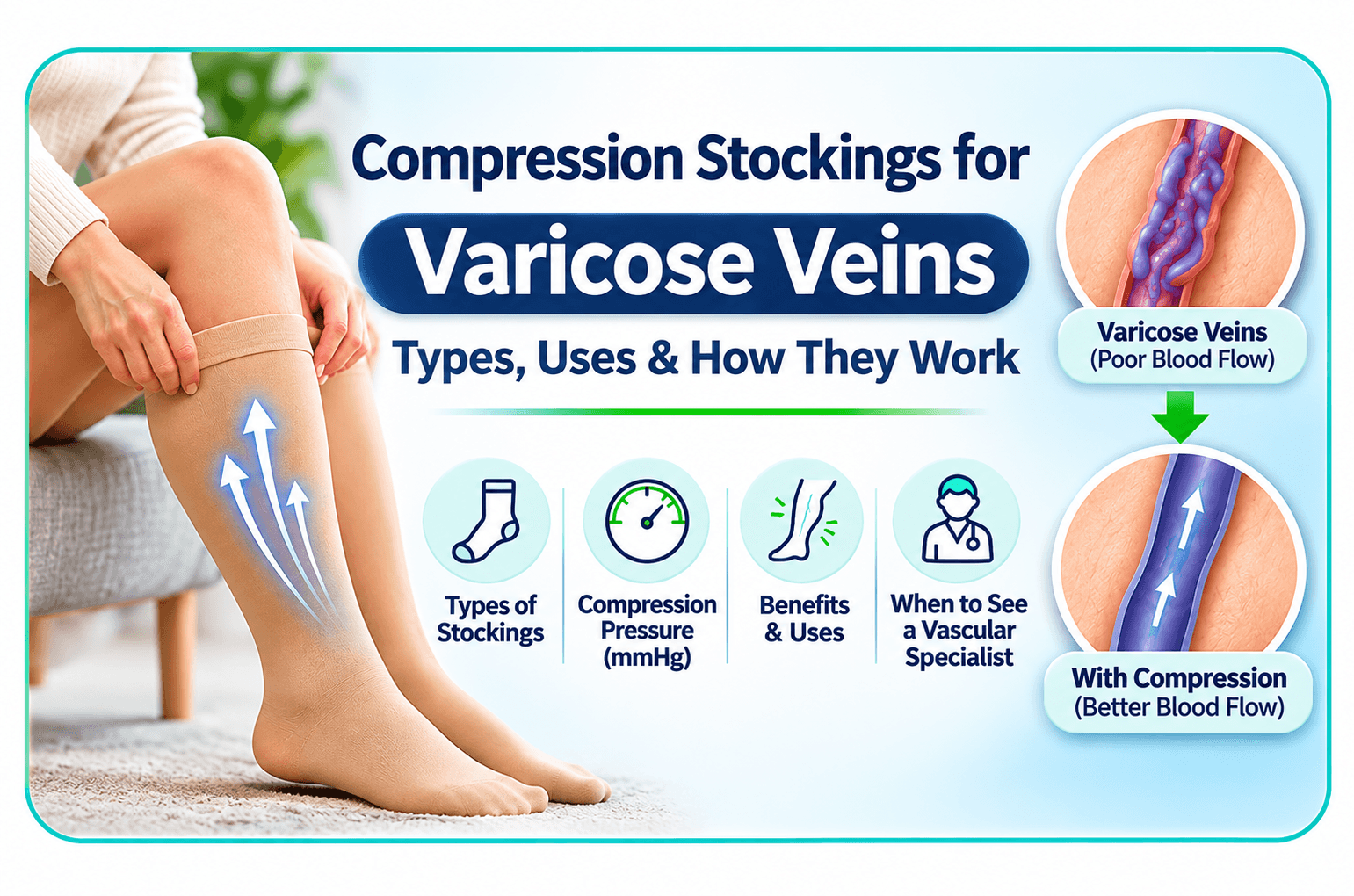
Compression Stockings for Varicose Veins: Types, Uses & How They Work
If your legs feel heavy and achy by the end of the day, or you have visible veins that bulge through the skin, you may have been told to try compression stockings. The confusion is understandable — there are several types, different pressure levels, and conflicting advice about how long to wear them and what they can and cannot do.
This article explains how compression stockings work for varicose veins, what the pressure numbers mean, how to choose and wear them correctly, and when to consult a vascular specialist.
Quick answer: Compression stockings may help reduce symptoms such as leg aching, heaviness, and swelling in people with varicose veins. They work by applying graduated pressure — strongest at the ankle — to support blood flow back up through the legs. The right pressure, length, and fit depend on the individual's symptoms and health history. Compression stockings do not permanently remove varicose veins or repair faulty venous valves.
What Are Compression Stockings for Varicose Veins?
Compression stockings are specially designed hosiery that apply controlled, graduated pressure to the leg — greatest at the ankle, decreasing as the stocking rises. This gradient, measured in millimeters of mercury (mmHg), is what distinguishes medical compression stockings from ordinary support socks, which apply uniform pressure and do not meet medical compression specifications.
For people with varicose veins, compression stockings are used to manage symptoms such as leg heaviness, swelling, and aching. They do not remove varicose veins or repair damaged venous valves, but can provide meaningful day-to-day relief.
Compression stockings, support socks, and anti-embolism stockings are not the same thing. The table below clarifies the differences, as these are frequently confused.
| Type | Main purpose | Typical context |
|---|---|---|
| Graduated medical compression stockings | Apply calibrated graduated pressure to support venous circulation | Venous conditions, oedema, symptom management, post-procedural use |
| Support socks | Varying degrees of comfort support; not standardised to medical compression specifications | Everyday comfort, mild fatigue, travel |
| Anti-embolism stockings (TED stockings) | Reduce clot risk in people with limited mobility; designed for recumbent use | Hospital and post-operative settings, as clinically indicated |
These are not interchangeable. Their pressure profiles, clinical indications, and intended use differ significantly.
How Do Compression Stockings Work?
The veins in the legs carry blood back toward the heart against gravity — a process that depends on the calf muscle pump and one-way valves that prevent backflow. Regular movement supports this process; see our guide on exercise and yoga for varicose veins for what helps and what to avoid. When these valves become damaged, blood pools in the lower veins, causing them to stretch and bulge beneath the skin: the underlying mechanism of varicose veins.
Graduated compression stockings apply controlled external pressure to the surface veins, reducing their diameter and making it easier for blood to move upward through the deep vein system. The pressure gradient — tightest at the ankle, decreasing toward the knee or thigh — actively assists venous return in a way that uniform pressure cannot.
The result, for many people, is reduced swelling, heaviness, and aching. Compression does not repair damaged valves — it counteracts their effect while worn. Benefit depends on the severity of the underlying condition, the compression level, and consistency of wear.
Benefits of Compression Stockings for Varicose Veins
The benefits of compression stockings for varicose veins are symptomatic rather than curative. A 2021 Cochrane review of 13 studies (over 1,000 participants) found consistent reports of improved aching, heaviness, and swelling with compression compared to no treatment. The certainty of this evidence was graded as low to very low, reflecting study limitations.
Reduction in leg heaviness and aching. External support reduces the venous pressure build-up that causes characteristic end-of-day discomfort.
Reduction in swelling. Compression assists venous return, which can reduce ankle and lower-leg swelling that accumulates with prolonged sitting or standing.
Support during prolonged standing or sitting. People who spend long hours on their feet or at a desk may find compression helpful for symptoms that worsen with immobility.
Use after varicose vein procedures. Following procedures such as ablation or sclerotherapy, compression is commonly used in the recovery period. The duration, pressure, and type vary depending on the procedure performed and individual factors; the treating clinician will specify what is required.
Compression stockings can help manage symptoms while they are worn, but they do not repair faulty venous valves or permanently eliminate varicose veins. They should not be considered a treatment that resolves the underlying venous reflux. If symptoms persist, worsen, or are accompanied by skin changes, a vascular assessment may help determine whether further treatment is appropriate.
Types of Compression Stockings for Varicose Veins
Compression stockings come in several styles, and the right choice depends on the location of venous disease, the degree of swelling, comfort preferences, and clinical guidance where relevant.
Knee-High Compression Stockings
Knee-high stockings cover the foot and calf, ending just below the knee. They are commonly used for symptoms affecting the lower leg and are generally easier to put on and more comfortable for daily wear than longer options. The appropriate length depends on the location of varicose veins, the degree of swelling, and individual assessment. Their limitation is that they provide no compression above the knee; if varicosities or swelling extend into the thigh, they will not adequately address those areas.
Thigh-High Compression Stockings
Thigh-high stockings extend from the foot to the upper thigh and are considered when disease or significant swelling involves the thigh, or when clinically recommended after certain procedures. Staying in place can be a challenge — a silicone top band or garter belt is often needed — and some people find them less comfortable for long-term wear, particularly in warm climates.
Compression Pantyhose
Compression pantyhose provide full-leg coverage and are an option for bilateral varicose veins or swelling, commonly used during pregnancy. They require two-leg measurements and are generally harder to put on and remove than knee-high options.
Open-Toe vs Closed-Toe Compression Stockings
Open-toe stockings leave the toes exposed, which suits warm climates and open-toed footwear, and makes it easier to monitor skin colour and sensation. Closed-toe stockings enclose the full foot and may be preferable when compression over the forefoot is also needed. Neither style is universally superior; comfort, climate, and foot-related needs are the deciding factors.
Compression Stockings Pressure Levels Explained
The pressure of a compression stocking is measured in mmHg at the ankle. Classification systems vary between countries — British Standard, European RAL, and CEN use different pressure bands and class names. The table below is a general guide; always refer to the system used by your clinician or pharmacist.
| Pressure Range (mmHg) | General Description | Typical Context | Key Considerations |
|---|---|---|---|
| 8–15 mmHg | Light support | Travel, tired or achy legs, preventive use, mild fatigue | Often available without prescription; not for significant venous disease |
| 15–20 mmHg | Moderate support | Mild varicose veins, prolonged standing, early pregnancy | Over-the-counter options available; may be appropriate for mild symptoms |
| 20–30 mmHg | Medical compression (corresponds broadly to Class II in several European systems) | Symptomatic varicose veins, mild to moderate oedema, post-procedural use | A commonly used range in some clinical settings; appropriate pressure depends on symptoms, circulation, leg measurements, skin condition and clinical assessment |
| 30–40 mmHg | Firm medical compression (broadly Class III in several European systems) | Chronic venous insufficiency, significant oedema, post-thrombotic syndrome | Arterial circulation should be assessed before use; professional guidance required |
| 40 mmHg and above | High-strength medical compression | Lymphoedema, severe chronic venous conditions, venous ulcers | Requires medical supervision and arterial assessment |
Important: Stronger compression is not automatically better. Higher pressure than clinically appropriate can cause discomfort and, in people with reduced arterial circulation, may be harmful. Class labels on packaging do not always correspond between systems — seek guidance from a clinician or pharmacist when in doubt.
Which Compression Stockings Are Suitable for Varicose Veins?
There is no single answer for every person. Stocking length is guided by where varicose veins and swelling occur — knee-high for lower-leg disease, thigh-high or pantyhose when disease extends further up. Pressure selection reflects severity: mild, uncomplicated varicose veins may respond to lower levels, while significant swelling or skin changes require higher, medically guided compression.
Skin condition matters — fragile skin, active wounds, or infections require evaluation before compression is applied. Arterial circulation must be considered in anyone with risk factors for peripheral arterial disease (older individuals, people with diabetes, smokers, those with cardiovascular disease); a clinician should assess circulation before compression is used if there is any doubt.
Comfort and practicality affect compliance. A stocking that is too difficult to put on or uncomfortable to wear consistently will not deliver its benefit.
How to Choose the Right Compression Stockings
Accurate sizing is essential. A stocking too tight in the wrong place can cause pressure injury; one too loose will not deliver therapeutic compression. Sizes are not interchangeable between brands.
Quick checklist before choosing compression stockings:
- Identify your symptoms: Determine whether the main concern is leg heaviness, aching, swelling, or visible veins.
- Check where symptoms occur: Lower-leg symptoms and swelling may require a different stocking length from symptoms extending into the thigh.
- Get accurate measurements: Measure your ankle and calf, and additional measurements where required by the stocking design.
- Understand the pressure level: Compression strength should match your condition and circulation — seek guidance if unsure.
- Check medical suitability: Seek professional guidance if you have diabetes, circulation problems, wounds, significant swelling, or other relevant health conditions.
- Follow fitting instructions: Stockings should fit smoothly without folds, rolling, or painful pressure.
Measure in the morning, before swelling accumulates, and measure both legs separately if they differ.
Key measurements:
- Ankle circumference at the narrowest point above the ankle bone
- Calf circumference at the widest part
- Thigh circumference (for thigh-high stockings)
- Leg length appropriate to the stocking style
Material. Breathable microfibre or cotton-blend fabrics make a practical difference for long-term wear in India's warm and humid climate.
Donning aids — rubber gloves or silicone donning tools — make putting on stockings considerably easier, particularly at higher compression levels.
For medical-grade compression (20 mmHg and above), professional fitting at a pharmacy or vascular clinic is advisable.
How to Wear Compression Stockings Correctly
Wrinkles, rolled edges, or incorrect positioning create pressure points. The following steps apply to most graduated compression stockings, though product instructions vary.
- Put them on in the morning, before swelling has accumulated. This is when the leg is at its smallest circumference.
- Gather the stocking by turning it inside out to the heel pocket, then work it gently over the foot and heel before pulling it up the leg in stages.
- Smooth out any wrinkles along the ankle and calf. No part of the stocking should be bunched or gathered, as this concentrates pressure unevenly.
- Check the heel pocket is correctly positioned at the heel.
- Ensure the top band sits flat without rolling. A rolled-down top creates a tourniquet effect.
- To remove, peel or roll the stocking gently down from the top to the ankle, then over the foot.
- Inspect the skin each time you remove the stockings. Check for persistent redness, indentation, or any signs of pressure and report these to a clinician.
What should compression stockings feel like? Correctly fitted compression stockings should feel firm and supportive — not painful. A snug sensation when first putting them on is normal, and this typically eases as the day progresses. They should not cause persistent pain, numbness, tingling, significant toe discolouration, or skin discomfort that does not resolve. If any of these occur, remove the stockings and seek advice about fit and suitability before continuing use.
How Long Should You Wear Compression Stockings?
For most people managing chronic venous disease, compression stockings are worn during the day — from getting up to bedtime, typically around 8–10 hours, aligning with the period when you are upright and venous pressure is greatest.
Nighttime use is generally not recommended for routine varicose vein management. When lying down, the rationale for compression is reduced. It is sometimes advised for a limited period following specific procedures or in venous ulcer management, as directed by the treating clinician.
Consistency matters. Occasional use is unlikely to deliver the same symptom control as daily wear. Following a procedure, the duration and type of compression required are specified by the treating clinician and should be followed as advised.
Who Should Be Careful Before Wearing Compression Stockings?
Compression stockings are generally well tolerated, but they are not appropriate for everyone without assessment. The following situations require attention before starting compression.
Peripheral arterial disease (PAD). The most important contraindication. In people with reduced arterial circulation, compression can worsen blood flow and cause tissue damage (Rabe et al., 2020). Risk factors include older age, diabetes, long-term smoking, and cardiovascular disease. Symptoms such as calf cramping on walking, cold feet, or rest pain warrant arterial assessment — this may involve ankle-brachial pressure index (ABPI) measurement — before compression is started.
Certain heart conditions. Decompensated heart failure requires evaluation before compression, as fluid redistribution from the legs can add strain to a compromised heart.
Severe sensory impairment. People with diabetic peripheral neuropathy may not detect pressure-related skin damage from poorly fitted stockings. Regular skin inspection is particularly important.
Skin conditions and wounds. Active infections, dermatitis, or leg wounds require evaluation before compression. Venous ulcers require proper clinical assessment and wound management — not self-initiated stocking use.
Incorrect sizing. A poorly fitting stocking, particularly one that rolls at the top or bunches, can create pressure injury regardless of underlying health.
If you have cardiovascular disease, diabetes, or any history of circulation problems, speaking with a pharmacist or doctor before purchasing compression stockings is a sensible precaution.
Can Compression Stockings Cure Varicose Veins?
No. Compression stockings do not cure varicose veins.
Varicose veins develop because damaged venous valves allow blood to pool in the superficial veins. Compression stockings do not repair these valves, and they do not close or permanently shrink the affected veins. When removed, the underlying dysfunction remains unchanged.
What they can do is manage the symptoms. For many people that daily relief is worthwhile — but compression does not alter the underlying disease, and symptoms may worsen over time in some people without further assessment or treatment. Persistent or worsening symptoms, skin changes, or complications despite compression are reasons to seek clinical evaluation.
Compression Stockings vs Varicose Vein Treatments
Compression stockings form one part of a broader range of options for managing varicose veins.
Compression therapy is non-invasive and is commonly used for symptom management in mild to moderate venous disease. It is also used alongside procedures in many clinical protocols. Its limitation is that it addresses symptoms rather than the underlying venous disease. For eligible patients, it is one option — not necessarily a mandatory first step before considering intervention.
Lifestyle measures — weight management, regular walking, leg elevation, and avoiding prolonged standing — complement compression and are relevant for most people with venous symptoms.
Endovenous thermal ablation (laser ablation and radiofrequency ablation) uses heat energy to close the diseased vein from within. These are now established minimally invasive treatments for symptomatic varicose veins and treat the underlying venous reflux rather than just the symptoms.
Sclerotherapy uses an injected chemical solution to close veins and is used for smaller varicosities and spider veins, or as foam sclerotherapy for larger veins.
Surgical ligation and stripping remains an option in selected cases, though minimally invasive techniques are now generally preferred.
The choice between options depends on symptoms, venous anatomy, Doppler ultrasound findings, individual health factors, and patient priorities. See our overview of varicose veins treatment options for a detailed comparison. A vascular specialist can advise on what is appropriate.
Do You Have to Try Compression Stockings Before Varicose Vein Treatment?
Not necessarily. Compression stockings are a useful option for symptom management, particularly when a person prefers conservative care or when a procedure is not suitable. However, they are not a mandatory trial that must be completed before intervention can be considered.
For people with symptomatic varicose veins who are suitable candidates for treatment, the 2023 guidelines from the Society for Vascular Surgery (SVS), American Venous Forum (AVF), and American Vein and Lymphatic Society (AVLS) note that a fixed compression trial should not be required as a prerequisite for intervention in eligible patients (Gloviczki et al., 2023). The decision on whether to start with compression, proceed to intervention, or use both together is made based on the underlying venous reflux, symptoms, health factors, anatomy, and individual preference — following a proper vascular assessment.
When Should You Consult a Vascular Specialist?
Compression stockings are appropriate for initial symptom management but are not a substitute for clinical evaluation when the situation warrants it.
Consider seeking assessment if:
- Heaviness, aching, or swelling persists or worsens despite wearing compression
- Skin changes appear around the ankle — brown discolouration, hardened skin, or eczema-like patches
- A wound or ulcer on the leg is slow to heal
- Sudden swelling, redness, warmth, or leg pain develops — to exclude deep vein thrombosis (DVT)
- Bleeding occurs from a varicose vein
- Symptoms are significantly affecting daily life
- You are unsure whether compression is appropriate for your medical history
When to seek prompt attention: Sudden leg swelling with pain, warmth, or rapidly spreading redness warrants timely DVT assessment. Chest pain, sudden breathlessness, or coughing blood should be treated as a medical emergency.
Frequently Asked Questions
Do compression stockings help varicose veins?
They can help manage symptoms — aching, heaviness, and swelling — by assisting venous return through graduated pressure. They do not remove varicose veins or repair damaged valves, but provide meaningful relief for many people during daily use.
Which compression stockings are best for varicose veins?
There is no single best type. The right choice depends on the location of varicosities, degree of swelling, leg measurements, and comfort. Knee-high stockings suit most lower-leg varicosities; thigh-high or pantyhose styles are considered when disease extends further up.
What compression level is commonly used for varicose veins?
The 20–30 mmHg range is commonly used for mild-to-moderate symptoms. Lower pressures (15–20 mmHg) may suit milder cases; higher levels are reserved for more advanced disease and require assessment including arterial circulation checks.
Can compression stockings remove varicose veins?
No. They manage symptoms but do not treat valve dysfunction or remove affected veins. Procedures such as laser ablation, radiofrequency ablation, sclerotherapy, or surgery are available for that purpose and should follow a vascular assessment. Read more about varicose veins treatment options.
How many hours a day should compression stockings be worn?
Most people wear them during waking hours — from getting up to bedtime, typically 8–10 hours. Exact duration depends on the clinical context and individual advice.
Can I sleep wearing compression stockings?
Routine overnight use is generally not recommended. When lying down, the rationale for compression is reduced. Nighttime use is occasionally indicated for specific clinical reasons but should be based on a clinician's guidance.
How do I know if my compression stockings are too tight?
Signs of an incorrect fit include persistent pain, numbness or tingling, skin indentation after removal, or toe discolouration. Correctly fitted stockings feel firm but not painful. Seek advice if these occur before continuing use.
Can compression stockings be worn while walking?
Yes. They are designed for daytime activity. Walking is beneficial for venous circulation — the calf muscle pump assists blood return, and wearing compression during activity combines both effects.
Can compression stockings make varicose veins worse?
Correctly fitted stockings at an appropriate pressure are unlikely to worsen varicose veins. Problems arise from incorrect sizing, rolled-down tops creating a tourniquet, or use at an inappropriate pressure in someone with arterial disease.
Do I need medical advice before buying compression stockings?
For 15–20 mmHg stockings, many people start without a prescription. With diabetes, heart disease, or circulation problems, speak with a doctor or pharmacist first. For 20–30 mmHg or above, professional advice on sizing and pressure is recommended. Anyone with leg wounds, skin changes, or significant swelling should seek assessment first.
Thinking About Your Options?
If leg heaviness, swelling, or visible varicose veins are affecting your daily routine, a vascular assessment may help identify the underlying cause and guide suitable management options.
The team at Aarogyam Surgicare can help you understand the available evaluation and treatment options, where appropriate.
Book a consultation to discuss your symptoms with a healthcare professional.
Conclusion
Compression stockings have a well-established role in the symptomatic management of varicose veins. Used correctly — properly sized, worn consistently from morning, and chosen at an appropriate pressure — they may help reduce leg heaviness, swelling, and aching for many people.
Their limits matter equally. They do not treat the underlying cause, and their benefits exist only while worn. For people whose symptoms persist, worsen, or progress to skin changes, compression is a management tool rather than a complete answer.
If you are unsure which type or pressure is right for you, or whether compression is safe given your health history, a vascular specialist can carry out a proper assessment and advise on all available options.
This article is intended for general information only and does not constitute personal medical advice. If you have symptoms related to varicose veins or concerns about your leg circulation, please consult a qualified healthcare professional.
References
- HealthLink BC / University of Michigan Health. Compression Stockings for Varicose Veins. Available at: https://uofmhealth.org/health-library/hw113550. Reviewed August 2023.
- Knight SL, Robertson L, Stewart M. Graduated compression stockings for the initial treatment of varicose veins in people without venous ulceration (Cochrane Review). Cochrane Database of Systematic Reviews, 2021. Available at: https://www.cochrane.org/CD008819.
- Rabe E, Partsch H, Morrison N, et al. Risks and contraindications of medical compression treatment — A critical reappraisal. An international consensus statement. Phlebology. 2020;35(7):447–460. Available at: https://pubmed.ncbi.nlm.nih.gov/32122269/.
- DermNet NZ. Compression Therapy. Available at: https://dermnetnz.org/procedures/compression.html.
- Canadian Medical Association Journal (CMAJ). Graduated compression stockings. CMAJ. Available at: https://www.cmaj.ca/custom-print/124890.
- Thuasne. Can you wear compression stockings at night? Available at: https://www.thuasne.com/en-au/blog/venous-insufficiencies/can-you-wear-compression-stockings-at-night.
- Medi. Medical compression stockings: How long should I wear them? Available at: https://www.medi.de/en/faq/compression-garments/wearing-duration/.
- BMJ. Compression stockings classification table. BMJ. 2006;332(7537):347–350. Available at: https://pmc.ncbi.nlm.nih.gov/articles/PMC1363917/.
- Phlebolymphology. Risks and contraindications of medical compression treatment. Available at: https://phlebolymphology.org/?p=9074.
- Gloviczki P, Lawrence PF, Wasan SM, et al. The 2023 Society for Vascular Surgery, American Venous Forum, and American Vein and Lymphatic Society clinical practice guidelines for the management of varicose veins of the lower extremities. Part II. Journal of Vascular Surgery: Venous and Lymphatic Disorders. 2023. Available at: https://pmc.ncbi.nlm.nih.gov/articles/PMC10953389/.
- MDPI. Compression hosiery classification systems. Journal of Personalised Medicine. Available at: https://pmc.ncbi.nlm.nih.gov/articles/PMC7874882.