Varicose Veins Treatment: Options, Procedures & When Treatment Is Needed
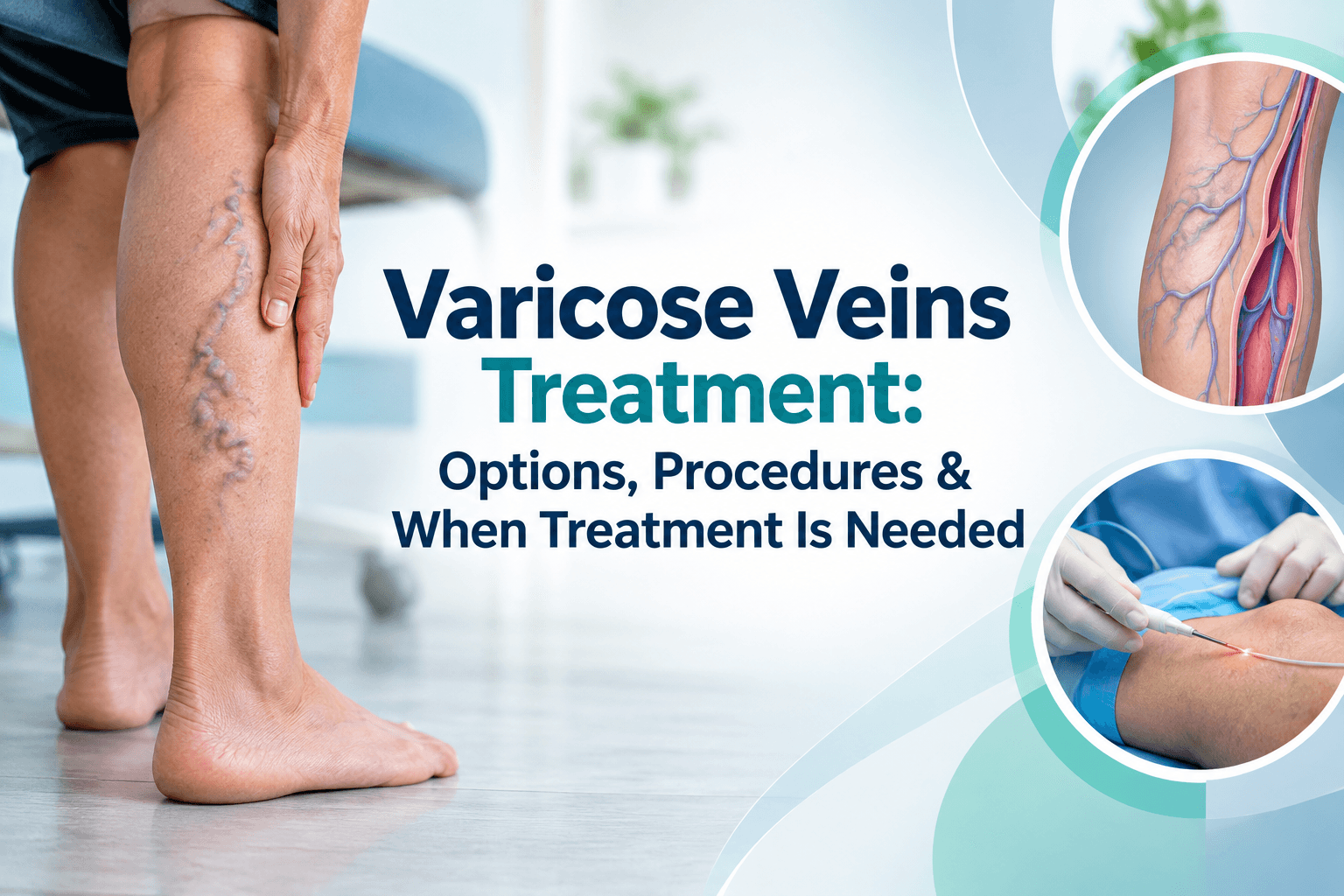
A prominent vein on the calf can look alarming, yet appearance alone does not say whether anything needs to be done. Some people have visible varicose veins for years with little discomfort. Others, with less striking veins, have heavy, aching legs by evening or notice skin changes around the ankle.
That gap is why varicose veins treatment is rarely a single, obvious decision. It depends on symptoms, on what an examination finds, and on what is happening inside veins that cannot be seen from outside. Options include self-care and compression, minimally invasive procedures and, in selected cases, conventional surgery. Which of them fits depends on the individual, and a proper assessment should come before any procedure is chosen.
The sections below take these questions in the order patients usually face them. They are background for a conversation with a vascular surgeon, not a substitute for one.
Do All Varicose Veins Need Treatment?
No. Many people have varicose veins without significant symptoms, and a visible vein is not an emergency. Whether treatment is advised depends on how much the veins affect the leg and daily life, and on what an examination shows.
Doctors tend to think in three broad groups. The first has visible veins but little or no discomfort. Advice and self-care may be all that is needed, with a review if anything changes. Some of these people dislike how the veins look and ask about treatment for that reason, which is a reasonable personal concern but separate from medical need.
The second group has symptoms: aching, heaviness, itching, swelling around the ankles, or legs that feel tired as the day goes on.
The third group has skin changes or other significant findings, such as darkening or hardening of the skin near the ankle, repeated vein inflammation, bleeding or an ulcer. These call for a prompt, thorough assessment.
Can varicose veins go away without treatment? Established ones do not usually disappear on their own. Self-care may ease symptoms but is not expected to reverse veins that have already enlarged. That still does not mean every varicose vein needs a procedure. Whether to watch, manage symptoms or treat is a decision to make with a doctor.
What Causes Varicose Veins?
Leg veins contain one-way valves that keep blood moving up towards the heart. In varicose veins, some of these valves stop working properly, so blood flows backward and collects, a problem called venous reflux. The raised pressure stretches the vein wall, and the vein becomes enlarged and twisted.
Some people are more likely to develop them: women, older adults, people carrying excess weight, those who have been pregnant, and people with a family history or an earlier deep vein thrombosis (a clot in a deep leg vein). Long periods of standing or limited movement, as in shop work, teaching or desk jobs, may also be associated with varicose veins or worsening symptoms. These raise the likelihood; they do not mean the veins will cause problems.
When Is Varicose Veins Treatment Usually Considered?
Treatment becomes a real consideration when veins are doing more than looking prominent. Each of the following may prompt further evaluation, and none means surgery is automatic.
- Persistent symptoms. Aching, heaviness or swelling that keeps returning, especially by evening, can be a reason to consider treatment, as can symptoms that limit work, walking or sleep.
- Skin changes. Brownish discolouration around the ankles, itchy patches or firm, thickened skin can reflect long-standing venous pressure and are a reason to look at the underlying veins.
- Recurrent inflammation. A vein that repeatedly turns red, hard and tender (superficial thrombophlebitis) can be a reason for referral, particularly when a faulty vein is suspected underneath.
- Bleeding. A vein close to the skin can bleed after a minor knock. Bleeding needs prompt medical attention and is a recognised reason for treatment.
- Venous ulcers. An open sore near the ankle that has not healed within about two weeks, or one that heals and returns, points to more advanced venous disease. For venous leg ulcers associated with superficial venous reflux, guidelines support treating the underlying reflux alongside appropriate compression and wound care.
Leg swelling also has other causes, including heart, kidney, liver and lymphatic conditions, so an examination comes first.
How Are Varicose Veins Evaluated Before Treatment?
The vein you can see is often only part of the problem. Treatment is planned from what is found underneath, not from the surface alone.
An assessment starts with your history: symptoms, how long you have had them, family history, pregnancies, past clots or earlier vein treatment. The doctor then examines both legs, looking at the veins, the skin and any swelling.
For many patients, especially those being considered for a procedure, the next step is a duplex ultrasound, often called a Doppler scan. It is painless and shows the veins and the direction of blood flow within them, including which veins have reflux and whether the deep veins are working normally. Vascular society guidelines recommend duplex ultrasound as the preferred test for evaluating venous reflux.
For people being assessed for suspected or recurrent varicose veins, particularly when treatment is being considered, duplex ultrasound is commonly used to confirm the diagnosis, map reflux and plan treatment.
Main Varicose Veins Treatment Options
Treatment includes conservative measures, minimally invasive procedures that close or remove problem veins, and, in selected cases, conventional surgery. These options are not a fixed sequence that every patient has to follow. A person with significant reflux and symptoms may be considered for a procedure early, while someone with mild symptoms may never need one.
Lifestyle and Symptom Management
Staying active, breaking up long spells of standing or sitting, raising the legs when resting, and addressing factors such as excess weight can make symptoms easier to live with. They do not repair faulty valves and are not expected to remove veins that have already formed.
Compression Therapy
Graded-pressure stockings or bandages can ease aching and swelling in some patients, and compression has an established role in healing venous ulcers. It is also used temporarily after a procedure when the surgeon advises it, for the period they specify.
Its limit is that it manages the effects without correcting the leaking vein. For symptomatic patients who are suitable for an intervention, NICE and vascular guidelines generally support addressing the underlying venous reflux rather than relying on compression stockings as the only long-term treatment. Long-term compression can still be reasonable when a procedure is unsuitable or is being deferred, as decided with the doctor.
Endovenous Thermal Ablation
"Endovenous" means inside the vein. A thin catheter is guided into the leaking vein under ultrasound, and heat applied from inside makes the vein wall seal shut. Radiofrequency ablation uses radio waves; endovenous laser treatment uses laser energy. Blood then flows through other healthy veins.
These procedures are usually done through a small skin puncture, often under local anaesthesia, and are mainly used when a main trunk vein, such as the great saphenous vein, is leaking. They suit many patients, but not all.
Non-Thermal Endovenous Treatments
Some endovenous methods close the vein without heat, for example with a medical adhesive (cyanoacrylate). They may be considered depending on the vein's anatomy, the findings and what a centre offers, so it is reasonable to ask which are available and appropriate for you.
Foam Sclerotherapy
A sclerosant, a medicine that closes veins, is mixed with gas to make a foam and injected into the affected vein, with ultrasound used to check where it goes. It causes scarring inside the vein, which closes it. Foam sclerotherapy can be considered for suitable trunk or branch veins, including when other procedures are unsuitable, and some patients need more than one session.
Phlebectomy
Bulging branch (tributary) veins near the skin can be removed through tiny cuts or punctures, usually once the main source of reflux has been assessed. Guidelines list phlebectomy and foam sclerotherapy as the main ways to treat visible tributaries.
Conventional Surgery
Ligation and stripping, in which the faulty vein is tied off at its upper end and removed, is an established operation. It may be considered when less invasive options are unsuitable or the clinical picture calls for it, and it is not automatically the first choice for every patient.
Treatment Options at a Glance
| Treatment | What it involves | When it may be considered | Important point |
|---|---|---|---|
| Lifestyle and self-care | Staying active, avoiding long unbroken standing or sitting, leg elevation | Mild symptoms or no complications; alongside any other treatment | Eases symptoms; does not remove established veins |
| Compression therapy | Graded-pressure stockings or bandages | Symptom relief, ulcer healing, temporary use after a procedure, or when a procedure is unsuitable | Does not correct the leaking vein |
| Endovenous thermal ablation | Heat (radiofrequency or laser) applied inside a leaking vein through a catheter | Symptomatic reflux in a main trunk vein | Depends on vein anatomy and assessment |
| Non-thermal endovenous treatment | Closing a vein from inside without heat | When anatomy and findings suit it and the centre offers it | Availability varies |
| Foam sclerotherapy | Ultrasound-guided injection of foam that closes selected veins | Suitable trunk or branch veins, or when other options are unsuitable | Repeat sessions are sometimes needed |
| Phlebectomy | Removing bulging branch veins through tiny skin openings | Visible tributary veins, usually after the main source is assessed | Often combined with trunk vein treatment |
| Conventional surgery | Tying off and removing the leaking vein (ligation and stripping) | When less invasive options are unsuitable or the findings call for it | Established option, not automatically first |
Endovenous Ablation: Where Do Laser and Radiofrequency Fit?
Laser and radiofrequency are two techniques within the wider group of endovenous procedures, used for one particular job: closing a main vein that has become leaky, from the inside. The vein is not taken out. Once it is sealed, blood travels through other healthy veins in the leg.
UK guidance (NICE) places endothermal ablation first for people with confirmed varicose veins and trunk vein reflux, then foam sclerotherapy, then surgery if the earlier options are unsuitable. US vascular societies likewise favour treating the vein over long-term stockings in symptomatic patients with trunk reflux who are candidates for a procedure. These are reference points rather than rules, and what is offered in India depends on the centre and the specialist.
Suitability turns on the vein's size and course, where the reflux sits and the assessment findings. A very twisted vein, or one lying very close to the skin, may call for another approach.
What Is the Best Treatment for Varicose Veins? How Doctors Choose
There is no single best treatment for varicose veins. The most suitable option depends on which veins are leaking, their size and position, the symptoms or skin changes present, the person's overall health and what is available locally. For many people with a leaking main trunk vein, guidelines favour a minimally invasive procedure, but the choice is made after examination and ultrasound.
That is why a friend's treatment may differ from the one your doctor suggests. Doctors weigh your symptoms and how much they affect daily life; the duplex findings, meaning which veins are affected and the pattern of reflux; the size, shape and position of those veins; any skin changes; previous treatment; overall health, including blood-thinning medicines or past clots; your preferences, for example about anaesthesia or time away from work; whether a procedure is suitable and available at the centre; and the surgeon's own assessment and experience.
Some typical patterns, as illustrations rather than rules:
- Symptoms with a leaking main trunk vein: endovenous ablation is usually considered first, then foam sclerotherapy or surgery if it is unsuitable.
- Bulging branch veins: phlebectomy or foam sclerotherapy, often alongside treatment of the trunk vein.
- Trunk vein unsuited to a catheter: foam sclerotherapy or surgery.
- Mild or no symptoms, no complications: advice, self-care and review.
- Skin changes or an ulcer with reflux: compression for healing, plus treatment of the leaking veins to reduce recurrence.
- Recurrent varicose veins: a fresh scan and an individual plan, since earlier treatment shapes the options.
- Unfit for a procedure, or declining one: conservative care, including compression.
What Are the Risks of Varicose Veins Treatment?
Every procedure carries some risk, and the type and likelihood differ by procedure and by patient. Possible complications vary by procedure and may include bruising, discomfort, skin discolouration, nerve irritation and, less commonly, blood clots in the leg veins (venous thrombosis). The specific risks depend on the procedure and the patient's health.
Ask the surgeon which risks apply to you and how they would be managed.
Can Varicose Veins Be Treated Without Surgery?
Often, but "without surgery" does not always mean "without a procedure." Mild cases without complications may be managed conservatively, with self-care, sometimes compression, and review. Others are treated with minimally invasive procedures such as endovenous ablation or foam sclerotherapy, done through a small puncture or injection rather than an operation and commonly performed as day-care procedures, usually under local anaesthesia. They are still medical procedures, with their own risks and follow-up.
Not everyone can avoid intervention, and some patients need conventional surgery.
Can Varicose Veins Come Back After Treatment?
Yes, they can. Treatment deals with the veins that were targeted. It does not remove the tendency that produced varicose veins, and other veins can become affected later, so describing the result as a permanent cure would be misleading. NICE advises that patients be told before treatment that new varicose veins may develop, that more than one session may be needed, and that recurrence is more likely when recurrent varicose veins are treated than at a first presentation.
Follow-up is therefore normal. The surgeon may arrange a scan to check that the treated veins have closed, and review you again if new symptoms appear. Staying active and avoiding long unbroken standing may help leg comfort, but nothing guarantees that recurrence will not happen.
What Is Recovery Like After Varicose Veins Treatment?
Recovery depends on the procedure, how much was treated and the person, so no single timeline applies. Minimally invasive treatments may allow a quicker return to normal activities than conventional surgery, but your surgeon can set expectations for you.
Most patients receive written instructions. They commonly cover:
- Activity. Usually walking and a gradual return to normal routines, with a period of avoiding strenuous activity.
- Wound and skin care. Keeping puncture sites or incisions clean, with advice on dressings and bathing.
- Compression. Stockings or bandages for a limited time, if advised.
- Follow-up. Often including an ultrasound to confirm the treated vein has closed.
Some bruising, tightness or tenderness along the treated vein can occur. Worsening pain, spreading redness, marked swelling or fever should be reported to the treating team without delay, and the urgent warning signs in the next section apply after a procedure too. Return to work depends on the job and the procedure, so plan it with your surgeon.
When Should You See a Doctor About Varicose Veins?
Seeing a vascular surgeon makes sense when varicose veins begin to affect how you live, or when something about them changes. Reasons include:
- aching, heaviness or pain that keeps returning or is getting worse
- swelling that does not settle with rest
- skin changes near the ankle, such as darkening, itching, dryness or thickening
- a vein that repeatedly becomes red, hard and tender
- any bleeding from a varicose vein
- a sore near the ankle that is slow to heal or keeps returning
- veins increasing in number or size, or symptoms that interfere with work, sleep or daily activity
Seek urgent care in these situations. If a varicose vein bleeds, lie down, raise the leg and press firmly on the spot with a clean cloth, and get medical help promptly if the bleeding does not stop or returns. Sudden swelling, pain, warmth or redness in one leg should be assessed the same day, because it can sometimes be caused by a blood clot in a deep vein (DVT), which is a different problem from a varicose vein and needs its own evaluation. Chest pain, sudden breathlessness or coughing up blood needs emergency care immediately (112 in India). These situations are uncommon, and most people with varicose veins never face them.
Questions to Ask Before Choosing Treatment
A consultation goes better with a few questions prepared:
- What is causing my varicose veins?
- Do I need a duplex ultrasound?
- Which of my veins are affected?
- Is treatment medically necessary in my case, or would it mainly be for appearance?
- Which treatment options are suitable for my condition?
- Why are you recommending this particular option?
- What are the possible risks and complications for me?
- What follow-up will I need, and what happens if the veins return?
Techniques vary between hospitals and cities in India, so also ask which procedures the centre performs regularly and who will perform yours. If you plan to use health insurance, confirm eligibility, documentation requirements and pre-authorisation with the hospital and insurer before treatment. A second opinion is reasonable, especially before surgery.
The Right Varicose Veins Treatment Depends on the Underlying Problem
Visible veins do not automatically need treatment. What counts is whether they cause symptoms or signs of progression, and what is happening in the valves and trunk veins underneath. That is why assessment comes first: a careful history, a leg examination and, where indicated, a duplex ultrasound show what is actually wrong.
Only then do the options make sense: self-care and compression, endovenous ablation, foam sclerotherapy, phlebectomy or conventional surgery. Someone with troublesome symptoms or skin changes should not be left waiting, and someone with painless veins should not be pushed towards a procedure.
If you are unsure where you stand, discuss your symptoms and findings with a qualified vascular professional and take time to decide on varicose veins treatment that fits your situation.
Frequently Asked Questions
1. Do all varicose veins need treatment?
No. Many people have varicose veins with few or no symptoms and need only advice and monitoring. Treatment is more likely to be considered when there are persistent symptoms, skin changes, repeated vein inflammation, bleeding or ulcers. A doctor decides after examining the legs and, where needed, scanning the veins. If symptoms change, it is sensible to have them reviewed.
2. Can varicose veins be treated without surgery?
Often, but "without surgery" does not always mean "without a procedure." Mild cases may be managed with self-care and sometimes compression, while others are treated with minimally invasive methods such as endovenous ablation or foam sclerotherapy. Some patients still need conventional surgery, depending on their veins. An examination and scan settle which applies to you.
3. What is the best treatment for varicose veins?
There is no single best treatment for everyone. For patients with confirmed trunk vein reflux who are suitable for intervention, guidelines commonly recommend endothermal ablation first. Foam sclerotherapy or surgery may be considered when other options are unsuitable. The final choice depends on vein anatomy, symptoms, ultrasound findings and individual circumstances.
4. Is laser treatment the only option for varicose veins?
No. Endovenous laser is one of several options. Others include radiofrequency ablation, non-thermal endovenous methods, foam sclerotherapy, phlebectomy and conventional surgery. The suitable choice depends on vein anatomy, reflux pattern, overall health and availability, and laser is not automatically the better one. Ask your surgeon why a particular option suits your veins.
5. Do compression stockings cure varicose veins?
No. Stockings may ease aching and swelling and help heal venous ulcers, but they do not repair a leaking vein or remove existing varicose veins. For symptomatic patients suitable for a procedure, guidelines generally support treating the underlying reflux rather than relying on stockings as the only long-term treatment. Doctors may still advise stockings temporarily around a procedure.
6. Can varicose veins come back after treatment?
Yes. Treatment addresses the veins that were targeted, but the tendency to develop varicose veins can remain, and other veins may be affected later. Some people need more than one session. Follow-up helps catch new or returning veins early, though recurrence cannot be ruled out. New veins can be assessed in the same way as before.
7. Which doctor treats varicose veins?
A vascular surgeon is one of the main specialists involved in assessing and treating varicose veins. Depending on the treatment and local practice, an interventional radiologist or another appropriately trained vein specialist may also be involved. A first visit usually includes an examination and often a duplex ultrasound. Ask about the surgeon's experience with the specific procedure you are offered.
Sources
- NICE. Varicose veins: diagnosis and management (CG168). https://www.nice.org.uk/guidance/cg168
- NICE. Surveillance report 2016, Varicose veins in the legs (CG168). https://www.nice.org.uk/guidance/cg168/resources/surveillance-report-2016-varicose-veins-in-the-legs-2013-nice-guideline-cg168-2307804013/chapter/Commentary-on-selected-new-evidence
- Gloviczki P, et al. 2022 Society for Vascular Surgery, American Venous Forum and American Vein and Lymphatic Society clinical practice guidelines for the management of varicose veins of the lower extremities, Part I. J Vasc Surg Venous Lymphat Disord.
- Management of varicose veins of the lower extremities, Part II (SVS/AVF/AVLS, 2023). J Vasc Surg Venous Lymphat Disord.
- Gloviczki P, et al. The care of patients with varicose veins and associated chronic venous diseases: clinical practice guidelines of the SVS and AVF. J Vasc Surg. 2011.
- O'Donnell TF, et al. Management of venous leg ulcers: clinical practice guidelines of the Society for Vascular Surgery and the American Venous Forum. J Vasc Surg. 2014;60(2 Suppl):3S-59S.
- NHS. Varicose veins: causes. https://www.nhs.uk/conditions/varicose-veins/causes
- HSE (Ireland). Varicose veins: treatment. https://www.hse.ie/conditions/varicose-veins/treatment/
Sources checked October 2026.