
AV Fistula Surgery: Procedure, Purpose & Recovery Guide
What Is an AV Fistula?
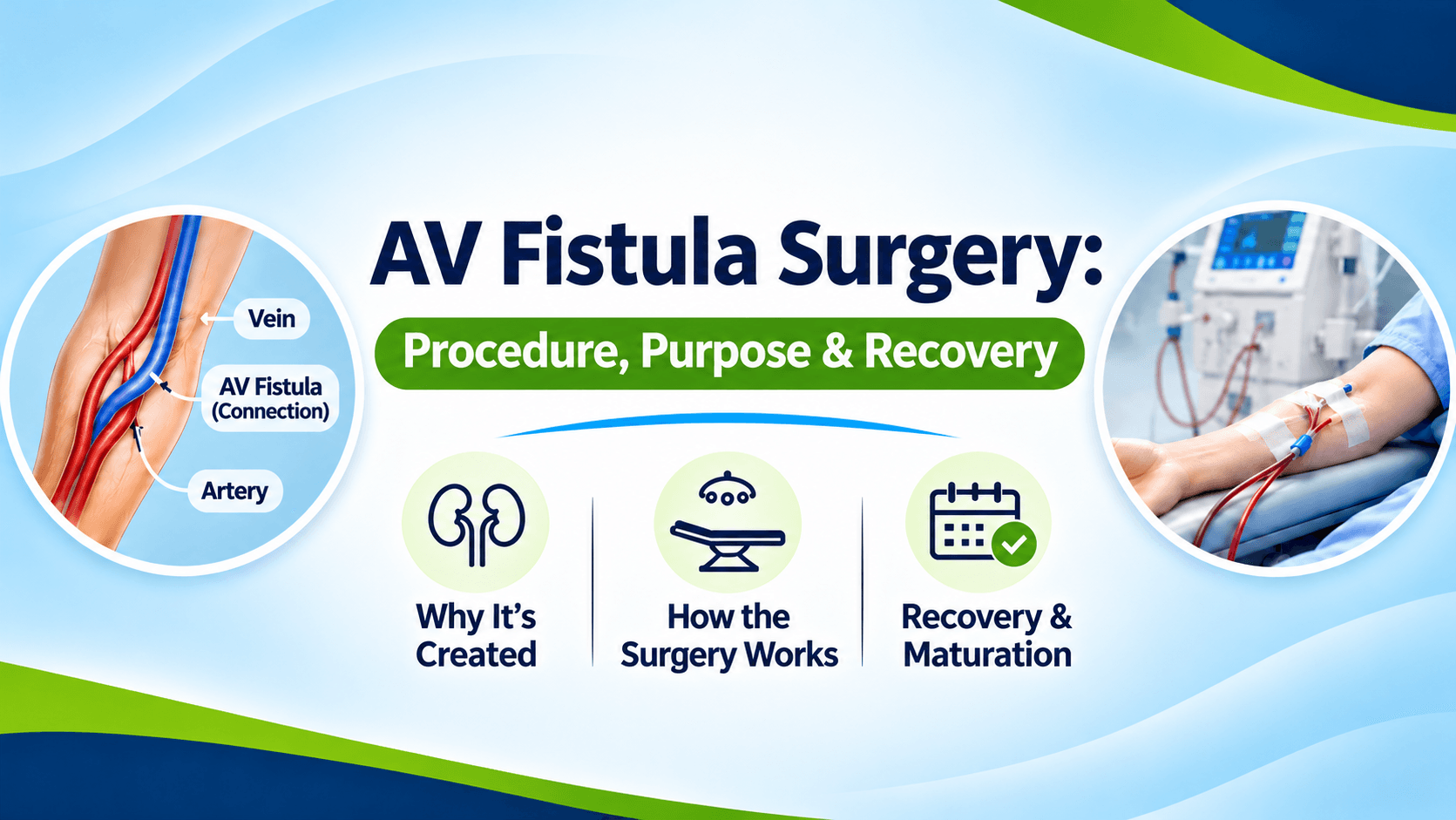
AV stands for arteriovenous — referring to both an artery and a vein. An arteriovenous fistula is a surgically created connection, called an anastomosis, between a nearby artery and vein, typically in the forearm or upper arm.
Under normal anatomy, arteries carry blood away from the heart under high pressure, and veins return it at lower pressure. When a surgeon joins them, the high-pressure arterial blood flows directly into the vein. Over time, this additional blood flow causes the vein to enlarge and its walls to thicken and strengthen — a process called arterialization. The result is a wider, more robust blood vessel that can tolerate the repeated needle insertions required for each hemodialysis session.
A well-matured fistula allows two needles to be placed at each dialysis session: one to draw blood into the dialysis machine for filtering, and one to return the cleansed blood to the body. This two-needle approach requires a vessel that is sufficiently large, close enough to the surface, and capable of maintaining adequate blood flow — all characteristics that develop during maturation.
Why Is an AV Fistula Created for Dialysis?
Hemodialysis works by drawing blood out of the body, filtering it through a dialysis machine to remove waste products and excess fluid, and returning it. This process is repeated multiple times each week, often for years. For it to work efficiently, the dialysis machine needs consistent access to a sufficient volume of blood.
Thin or fragile veins cannot sustain this long-term. A reliable, high-flow access point is essential for effective treatment — and poor access quality directly affects the quality of dialysis a patient receives.
For many patients who need long-term hemodialysis, an AV fistula is an important vascular access option because it uses the patient's own blood vessels and is generally associated with lower infection risk and better long-term access outcomes than a dialysis catheter. However, the most suitable access depends on the patient's vascular anatomy, overall health, expected dialysis needs and treatment preferences. A nephrologist and vascular access surgeon help determine which option is appropriate.
Because a fistula needs weeks to months to mature before it can be used, access planning ideally begins well before dialysis is needed. A nephrologist will typically refer a patient to a vascular surgeon for fistula evaluation while kidney function is still declining — not after failure has already occurred.
Who Needs AV Fistula Surgery?
AV fistula surgery is most commonly considered for people with advanced chronic kidney disease who are expected to require long-term hemodialysis. This includes patients approaching end-stage kidney disease and those whose kidney function has already declined to the point where renal replacement therapy is being planned.
A nephrologist — a kidney specialist — typically leads a patient's care through the progression of chronic kidney disease and determines when dialysis planning should begin. If hemodialysis is the chosen treatment, the patient may then be referred to a vascular surgeon, who evaluates whether the person's vascular anatomy is suitable for fistula creation.
Not everyone is an appropriate candidate. Factors such as small or damaged veins, arterial disease, previous arm surgeries, blood clotting disorders, or other health conditions may affect whether and where a fistula can be created. A person who is currently receiving dialysis through a catheter may also undergo fistula surgery to establish a more durable form of access.
The timing of the operation matters. A fistula created too early may fail before dialysis is needed; created too late, the patient may need to begin dialysis through a catheter while waiting for the fistula to mature. The right timing is determined by the individual's medical team.
Types of AV Fistulas
The choice of fistula type and location depends on the patient's vascular anatomy, the condition of available veins and arteries, and the surgeon's clinical assessment. A preoperative ultrasound vascular mapping study may be used to evaluate vessel suitability.
Where possible, surgeons generally prefer to create a fistula in the nondominant arm and at the most distal (furthest from the shoulder) suitable site, preserving more proximal vessels for future access if needed.
Radiocephalic AV Fistula
This fistula connects the radial artery to the cephalic vein at the wrist. It is the most distal option in the arm and, when feasible, is often the first consideration. Smaller veins at this site may be associated with a higher rate of non-maturation in some patients, so vessel suitability is carefully assessed beforehand.
Brachiocephalic AV Fistula
Located in the upper arm, this fistula connects the brachial artery to the cephalic vein near the elbow. The larger vessels at this site tend to support more reliable blood flow, though the more proximal location uses vessels that could otherwise be preserved for future access.
Brachiobasilic AV Fistula
This fistula connects the brachial artery to the basilic vein in the upper arm. Because the basilic vein runs deeper beneath the skin than the cephalic vein, it may not be easily accessible for dialysis needles in its natural position. Some surgical approaches involve a second-stage procedure to bring the vein closer to the surface — a process called transposition — which makes it more accessible for cannulation.
There is no universally correct fistula type for every patient. The surgeon's recommendation is based on individual anatomy and overall clinical circumstances.
How Is AV Fistula Surgery Performed?
Preoperative Assessment
Before surgery, the patient undergoes a comprehensive evaluation that typically includes a review of medical history, current kidney disease status, and existing medications. A physical examination of the arm vessels is standard. Many centres also perform vascular mapping using Doppler ultrasound to assess the suitability of arteries and veins before selecting a surgical site.
Medication adjustments may be discussed — particularly regarding blood thinners, antiplatelet drugs, or medications that affect anaesthesia. Patients are generally given specific fasting instructions if general or regional anaesthesia is planned. Any questions about preparation should be directed to the treating surgical team.
Anaesthesia During AV Fistula Surgery
The anaesthesia approach depends on the specific procedure, the patient's health, and the preference of the surgical team. Most AV fistula surgeries are performed under local anaesthesia with or without sedation, or under a regional nerve block, which numbs the entire arm. General anaesthesia is used less commonly but may be considered in certain situations.
A regional nerve block typically takes effect before the operation and can keep the arm comfortably numb for several hours afterward, which may reduce early postoperative discomfort.
Step-by-Step AV Fistula Creation
- Preparing the surgical area. The arm is cleaned and sterile draping applied. The site of the planned anastomosis is confirmed.
- Making the incision. A small incision is made over the chosen site, exposing the underlying artery and vein.
- Identifying and preparing the vessels. The surgeon carefully isolates the relevant artery and vein, controlling blood flow temporarily while the connection is prepared.
- Creating the anastomosis. The artery and vein are joined using fine sutures, creating an opening between them. This is the anastomosis — the core of the fistula.
- Checking blood flow. Once the anastomosis is complete and blood flow restored, the surgeon checks that blood is moving freely through the connection.
- Assessing the thrill. A vibration called a thrill, caused by turbulent high-flow blood moving through the fistula, can often be felt and heard immediately after the anastomosis is opened.
- Closing the incision. The wound is closed with sutures or staples and covered with a dressing.
The operation is frequently performed as a day procedure, meaning the patient may be discharged the same day, depending on the type of anaesthesia used and the patient's overall condition. Inpatient admission may be required in some cases.
Immediately After the Operation
Following surgery, the arm is monitored for signs of adequate blood flow through the fistula. The thrill and, where appropriate, the bruit — the rushing sound heard through a stethoscope — may be assessed by clinical staff. The wound is dressed, and pain management is provided. Patients typically receive discharge instructions covering arm care, wound management, activity restrictions, and when to seek medical attention.
Is AV Fistula Surgery Painful?
The surgery itself is performed under anaesthesia, so patients do not feel the procedure while it is taking place. Regional nerve blocks may leave the arm numb for several hours after the operation.
After this wears off, it is common to experience some degree of discomfort around the surgical site, as well as bruising and swelling in the arm and hand. This is a normal response to both the incision and the altered blood flow. Most patients find the discomfort manageable with prescribed or recommended pain relief — typically mild analgesics. Severe or worsening pain after the initial recovery period should be discussed with the medical team.
Individual experience varies considerably. Some patients have minimal discomfort; others find the first few days more uncomfortable. Following the prescribed pain management plan and keeping the arm elevated as advised can help during this phase.
How Long Does AV Fistula Surgery Take?
The operative time for AV fistula creation varies depending on the site of the anastomosis, the complexity of the patient's anatomy, and whether any additional surgical steps are required. Many straightforward fistula creations are completed within one to two hours of operative time. More complex procedures, or those requiring vein transposition, may take longer.
This does not include preoperative preparation, anaesthesia administration, or postoperative recovery-room monitoring. Total time at the surgical facility is typically several hours, even for outpatient procedures. The surgical team can provide more specific guidance based on the planned operation.
AV Fistula Surgery Recovery
Recovery from AV fistula surgery involves two overlapping but distinct processes: healing of the wound and maturation of the fistula itself. These are not the same thing. A healed incision does not mean the fistula is ready for dialysis.
The First 24–48 Hours
Mild discomfort, swelling, and bruising around the incision site are common in the first two days. Some patients experience temporary changes in sensation after surgery, but persistent or significant numbness, coldness, weakness or pain in the hand should not be assumed to be part of normal recovery. Contact the surgical team promptly if these symptoms occur, particularly if they are worsening. Where advised, keeping the arm elevated above heart level can reduce swelling. Dressings should remain in place and kept dry as instructed. Any significant bleeding through the dressing should be addressed promptly.
Patients should take prescribed pain relief as directed and avoid any heavy use of the arm. Activity restrictions during this period are usually strict.
The First Few Days
As initial swelling subsides, wound care becomes the main focus. Dressings are typically changed according to instructions from the clinical team. Dissolvable sutures generally dissolve on their own within around ten days; non-dissolvable sutures or staples may need removal at a follow-up appointment.
Hygiene around the wound site should follow the medical team's specific guidance — usually avoiding submerging the arm in water until the wound has adequately healed. Unnecessary pressure on the fistula arm — from tight clothing, watches, or sleeping on that side — should be avoided.
Recovery Over the Following Weeks
As weeks pass, the incision heals and the vein begins to respond to the increased arterial blood flow. Patients may notice visible changes in the arm as the vein gradually enlarges. Regular follow-up appointments allow the clinical team to assess healing and monitor fistula development.
A gradual return to everyday activities is generally guided by the medical team's instructions. Heavy lifting and strenuous use of the fistula arm are typically restricted for a period following surgery. The treating team will confirm when specific activities can resume.
How Long Does an AV Fistula Take to Mature?
Maturation refers to the process by which the fistula vein becomes sufficiently large, accessible, and high-flow to support reliable dialysis access. Following surgery, the arterial blood flowing into the vein causes it to dilate and its wall to strengthen progressively.
An AV fistula often needs several weeks to develop before it can be used for dialysis. Healthcare teams may begin assessing its maturation within the first few weeks after surgery — the UK Kidney Association guideline recommends an initial maturity assessment within 2–6 weeks — while the time required for successful cannulation varies from patient to patient. Some fistulas become usable relatively early, while others may need several months or additional treatment. This does not mean every fistula is ready for cannulation at six weeks.
Factors that influence maturation include the size and health of the vessels used, the patient's age, blood pressure, cardiovascular status, the presence of diabetes, and the specific site of the anastomosis. There is no single maturation schedule that applies universally.
Readiness for dialysis is determined through clinical assessment — feeling for an adequate thrill, checking vessel diameter, and assessing how close the vein is to the surface for needle access. Ultrasound evaluation is often used where clinical assessment is uncertain. Formal criteria used in clinical practice typically consider vein diameter and blood flow rate alongside the ability to successfully cannulate the vessel.
An AV fistula should not be considered ready for dialysis simply because a certain number of weeks has passed. The treating healthcare team must assess the fistula before it is used.
When maturation is delayed, the vascular team may evaluate for underlying causes such as stenosis near the anastomosis or inadequate vessel size. Further investigation and intervention — such as balloon dilation of a narrowed segment — may be considered to assist maturation. Alternative access planning may also be discussed.
AV Fistula Care After Surgery
Protecting and monitoring the fistula arm is an ongoing responsibility after surgery. The following general principles apply, though specific instructions should always come from the treating clinical team.
Protecting the access arm:
- Where possible, avoid blood pressure measurements on the fistula arm, unless a healthcare professional determines it is medically necessary.
- Where possible, avoid blood draws or intravenous cannulations on that arm, unless a healthcare professional determines it is medically necessary.
- Do not wear tight sleeves, cuffs, watches, or jewellery that may press on the fistula.
- Do not sleep on the fistula arm or allow it to be compressed.
- Do not carry heavy bags or straps over the access arm.
Wound and hygiene care:
- Follow the team's specific instructions for dressing changes and when to allow the arm to get wet.
- Keep the wound clean and watch for signs of infection.
Monitoring blood flow:
- Check for a thrill — the gentle buzzing or purring sensation felt over the fistula — daily as instructed.
- Contact the dialysis or clinical team if the thrill changes significantly or cannot be felt.
During recovery:
- Avoid heavy lifting with the fistula arm for the period specified by the medical team.
- Attend all scheduled follow-up appointments.
Patients may also be given hand exercises, such as gentle squeezing of a soft ball, to encourage blood flow through the fistula during the maturation period. This should only be done if specifically advised.
How to Check Whether Your AV Fistula Is Working
Regular self-monitoring is an important part of fistula care. Patients are usually taught how to check their access before they leave the hospital or at their first follow-up visit.
What Is a Thrill?
A thrill is a gentle vibration or buzzing sensation that can be felt by lightly placing the fingertips over the fistula. It is caused by blood moving rapidly through the surgically created connection between the artery and vein. Many patients describe it as a continuous soft purring — a bit like placing a hand on a running engine. Feeling a consistent thrill is generally reassuring because it suggests blood is flowing through the fistula. However, the thrill alone cannot confirm that the access is ready for dialysis or free of complications. The healthcare team must assess the fistula's function.
What Is a Bruit?
A bruit is the sound version of the same blood flow. Healthcare professionals can hear it by placing a stethoscope over the fistula — it typically sounds like a continuous, low whooshing or rushing sound. The bruit is a clinical assessment tool used by the dialysis and surgical team rather than a routine patient check.
How Patients May Monitor Their Access
Patients are typically advised to check their thrill at least once daily — often first thing in the morning, before dialysis, or at any point where the fistula has been compressed or felt unusual. If the thrill cannot be felt, or feels weaker or different than usual, the clinical team should be contacted promptly.
Self-monitoring is not a substitute for clinical assessment. Regular reviews by the treating team, and ultrasound monitoring where indicated, remain essential throughout the life of the fistula.
Potential Complications of AV Fistula Surgery
Complications can occur with any surgical procedure, and AV fistula surgery is no exception. Not every patient will experience complications, but understanding what to watch for enables prompt treatment when problems arise. The vascular surgery team at Aarogyam Surgicare monitors patients for these conditions as part of ongoing access care.
Bleeding and bruising — Some bleeding from the wound site in the immediate postoperative period is not unusual. Significant or persistent bleeding requires medical attention.
Infection — Signs include increasing redness, warmth, swelling, or discharge from the wound, often accompanied by fever. Any suspected infection should be assessed by the clinical team promptly.
Thrombosis (clotting) — The fistula may clot, particularly in the early weeks after surgery. This typically presents as a loss of the thrill. Prompt evaluation is important, as early thrombosis may sometimes be treated to restore patency.
Failure to mature — A proportion of AV fistulas do not develop adequately to support dialysis. This may occur due to underlying vessel characteristics or anastomotic issues and may require further investigation or alternative access planning.
Stenosis — Narrowing within or near the fistula can restrict blood flow. Stenosis is one of the leading causes of access dysfunction and may develop at any point during the life of the fistula. It may be treated with balloon dilation (angioplasty) or surgical revision where appropriate.
Aneurysmal changes — Repeated needle insertions over time can contribute to focal dilations in the fistula vein. These are generally monitored and managed by the access team.
Steal syndrome — In some patients, blood is redirected away from the hand and fingers toward the fistula, reducing circulation to the lower arm. This may cause the hand to feel cold, weak, or painful. Steal syndrome can range from mild to severe and requires medical evaluation.
Nerve-related symptoms — Numbness, tingling, or weakness in the hand or fingers can follow surgery or develop later. These symptoms should always be reported to the clinical team.
High flow-related issues — In some cases, the fistula develops very high blood flow over time, which may rarely affect cardiac function. This is monitored as part of ongoing access care.
Warning Signs After AV Fistula Surgery
Certain symptoms require prompt medical attention. Do not delay seeking help for any of the following.
Contact your clinical team or seek urgent medical care if you notice:
- Sudden loss of the thrill, or a significant change in how the thrill feels
- Persistent or heavy bleeding that does not stop with gentle pressure
- Rapid or severe swelling in the arm or hand
- Increasing pain around the fistula site that is not improving
- Redness, warmth, or red streaking around the wound or fistula
- Wound discharge, pus, or an unpleasant smell from the site
- Fever or general signs of infection
- Cold, pale, blue, or numb fingers on the fistula arm
- Significant weakness in the hand
- Severe pain in the hand that is out of proportion to expected recovery
These symptoms can indicate complications that may progress quickly if not treated. When in doubt, contact your dialysis unit, kidney clinic, or surgical team without delay. If symptoms are severe or rapidly worsening, seek emergency care.
AV Fistula vs AV Graft vs Dialysis Catheter
The three main types of hemodialysis vascular access each have distinct characteristics, advantages, and limitations. The right choice depends on the individual patient's anatomy, health status, urgency of dialysis, and overall treatment plan — no single option is appropriate for every person.
| Access Type | What It Is | General Advantages | Important Considerations |
|---|---|---|---|
| AV Fistula | Surgical connection between the patient's own artery and vein, usually in the arm | Uses natural vessels; associated with lower infection risk and longer patency compared with other access types | Requires maturation period of weeks to months before use; not feasible for all patients |
| AV Graft | Synthetic or biological tube surgically placed to connect an artery and vein | Depending on the graft type and clinical circumstances, may become usable sooner than a newly created fistula; suitable when suitable veins are unavailable for a fistula | Generally more prone to infection and clotting than a fistula; timing of use is determined by the surgical team |
| Dialysis Catheter | Flexible tube inserted into a large central vein, typically in the neck or chest | Can be used immediately; does not require surgery or healing period | Associated with a greater risk of bloodstream infection and may have limitations in blood flow or dialysis performance compared with well-functioning permanent access, depending on the catheter and clinical circumstances; generally considered a temporary or bridge option |
Access choice is always individualised. Patients who are not candidates for a fistula may do well with a graft, and catheters serve an important role when access is urgently required or when permanent access is being established. The goal in most cases is to transition to permanent vascular access as soon as clinically appropriate.
What Happens If an AV Fistula Does Not Mature?
Non-maturation — when the fistula fails to develop adequately for dialysis use — is a recognised challenge. Studies suggest that a meaningful proportion of newly created fistulas do not mature within the expected timeframe, though estimates vary across patient populations and definitions.
When maturation is delayed or absent, the vascular access team will typically investigate the cause. Ultrasound evaluation can identify common contributors such as stenosis near the anastomosis, accessory veins that divert flow away from the main fistula vein, or inadequate vessel development.
Depending on the findings, options may include:
- Percutaneous intervention — Balloon angioplasty to dilate a stenotic segment and improve blood flow toward the fistula vein.
- Surgical revision — Modifying the anastomosis or addressing other structural problems.
- Accessory vein ligation — Closing off veins that compete with the main fistula for blood flow.
- Alternative access planning — If the fistula cannot be salvaged, the team will discuss other options, such as an AV graft or continued catheter use while a new access is planned.
Non-maturation does not mean the patient has no further options. The treating team will assess each situation individually and develop an access plan suited to the patient's circumstances.
Frequently Asked Questions About AV Fistula Surgery
What is AV fistula surgery?
AV fistula surgery is a procedure in which a vascular surgeon creates a direct connection between an artery and a vein — usually in the arm — to produce a durable access point for hemodialysis. The resulting access, called an arteriovenous fistula, uses the patient's own blood vessels and must mature before it can be used for dialysis.
Why is an AV fistula needed for dialysis?
Hemodialysis requires repeated access to a sufficient volume of blood over many sessions each week. Standard veins cannot sustain this long-term. An AV fistula creates a high-flow, robust access point that can support the demands of regular dialysis over an extended period.
Is AV fistula surgery painful?
The surgery is performed under anaesthesia, so the patient does not feel pain during the procedure. After the anaesthetic wears off, some discomfort, bruising, and swelling are common. Most patients manage this with prescribed pain relief. Severe or worsening pain should be reported to the medical team.
How long does AV fistula surgery take?
Operative time for a straightforward fistula creation is often in the range of one to two hours, though this varies depending on the site and complexity of the procedure. Total time at the hospital or surgical facility, including preparation and recovery monitoring, will be longer.
How long does an AV fistula take to mature?
Maturation typically takes at least several weeks to a few months, and varies considerably between patients. Many fistulas require three to six months or longer to develop adequately. Readiness for dialysis must be confirmed by the clinical team through assessment of the vessel — not by time alone.
How long does recovery take after AV fistula surgery?
Wound healing generally occurs over one to two weeks, while fistula maturation may take several months. These are separate processes. Most patients are able to return to light activities relatively quickly, but the medical team will advise on specific timelines based on individual progress.
Can I use my arm normally after AV fistula surgery?
Most patients return to ordinary daily activities, though certain restrictions apply — particularly during recovery and for the life of the fistula. Where possible, blood pressure measurements, blood draws, and intravenous access on the fistula arm are generally avoided unless a healthcare professional determines it is medically necessary. The treating team will provide specific guidance on what to avoid and when normal use can resume.
How do I check if my AV fistula is working?
Patients are taught to check for a thrill — a gentle buzzing sensation felt over the fistula — typically daily. A strong, consistent thrill indicates blood is flowing well. Changes to the thrill should be reported to the clinical team. This check is a helpful monitoring tool but does not replace professional clinical review.
What should I do if I cannot feel my AV fistula thrill?
Contact your dialysis unit or clinical team as soon as possible. A loss of thrill may indicate a problem with blood flow, such as thrombosis or compression. Early intervention offers the best chance of restoring the access. If you cannot reach your team and symptoms are concerning, seek emergency medical care.
Can an AV fistula fail to mature?
Yes. A proportion of fistulas do not develop adequately to support dialysis. When this occurs, the access team will investigate the cause and may recommend further interventions — such as balloon angioplasty or surgical revision — to assist maturation. If these are not successful, alternative access options will be discussed.
Conclusion
AV fistula surgery plays a central role in the care of people with kidney failure who require long-term hemodialysis. For suitable patients, it provides a durable, lower-risk access option that — when well-matured and carefully maintained — can support dialysis treatment for years. Early access planning, ideally before dialysis is urgently needed, gives the fistula the time it needs to develop properly.
Recovery, maturation, and ongoing arm care all require active attention. Regular monitoring, prompt reporting of warning signs, and consistent follow-up with the treating team are as important as the surgery itself. Each patient's journey with vascular access is shaped by individual anatomy, health status, and the ongoing expertise of their kidney and surgical care team.
If you or someone you care for is approaching dialysis and have questions about vascular access options, the team at Aarogyam Surgicare is available to discuss your specific situation. Our vascular surgery specialists work alongside nephrology teams to help patients understand their access options and plan appropriately for the road ahead.
Editorial note: This article is intended for general informational and educational purposes. Medical information is prepared using relevant clinical guidelines and patient-education resources. It is not a substitute for professional medical advice, diagnosis or treatment.
References and Further Reading
The following clinical guidelines and patient-education resources were used in preparing this article:
- National Kidney Foundation. KDOQI Clinical Practice Guidelines for Vascular Access. kidney.org
- UK Kidney Association. Clinical Practice Guideline on Vascular Access for Haemodialysis. link.springer.com
- Kidney Care UK. Arteriovenous (AV) Fistula Formation. kidneycareuk.org
- Cambridge University Hospitals NHS Foundation Trust. Care of Your Arteriovenous Fistula (AVF) After Surgery. cuh.nhs.uk
This article is intended for general informational and educational purposes only and should not be considered a substitute for professional medical advice, diagnosis or treatment. Decisions about dialysis access and AV fistula surgery depend on individual medical circumstances and should be made in consultation with qualified healthcare professionals. If you experience concerning symptoms related to your fistula or vascular access, seek medical attention promptly.