Laser Treatment for Varicose Veins: Procedure, Suitability & Recovery
Written by: Aarogyam Surgicare Editorial Team
Many people hear the word "laser" in a vein clinic and picture a beam passed over the skin to make bulging veins disappear. The treatment most often meant by laser treatment for varicose veins is quite different. It happens inside the vein, guided by ultrasound, and its target is the faulty vein beneath the surface rather than the visible lump above it.
That difference shapes almost everything else: who is offered it, what the leg looks like afterwards, why a second procedure is sometimes discussed, and why a scan has to come first. This article explains how endovenous laser treatment is carried out, where it fits among the other options, what risks and limits apply, and which questions are worth asking before you agree to it. If you are still deciding whether your veins need any treatment at all, our broader guide to varicose veins treatment options and when treatment is needed covers that decision. This article assumes a specialist has already raised the possibility of a procedure.
What "Laser Treatment" Means for Varicose Veins
Two quite different things are called laser treatment in vein care.
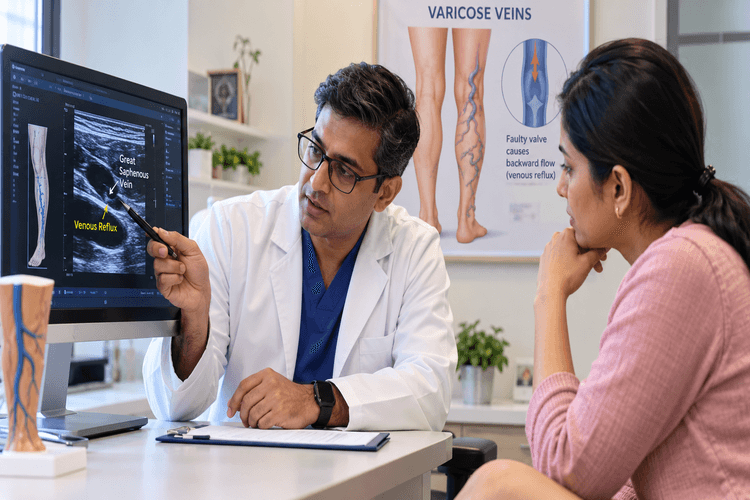
Endovenous laser treatment (EVLT), also called endovenous laser ablation, uses a thin laser fibre placed inside a leaking trunk vein, usually the great saphenous vein that runs along the inner leg. Heat from the laser seals the vein wall. This is the procedure that guidelines discuss for varicose veins with venous reflux, the backward flow of blood caused by failing valves.
Surface laser treatment is aimed at tiny red, blue or purple thread veins (spider veins). The NHS notes that these are different from varicose veins and are usually harmless. Treating them is generally a cosmetic matter and has no bearing on the choice of procedure for varicose veins.
Endovenous laser belongs to a group called endothermal ablation, meaning closure of a vein with heat. Radiofrequency ablation is the other member of that group. When NICE guideline CG168 recommends endothermal ablation as the first-line procedural option for suitable patients with confirmed varicose veins and truncal reflux, it is naming both techniques, not laser alone. If ablation is unsuitable, the guideline recommends ultrasound-guided foam sclerotherapy, and if that is unsuitable too, surgery.
How Endovenous Laser Treatment Is Done
The NHS describes the procedure in broad steps, and the sequence is similar in most centres:
- A local anaesthetic is given to reduce pain, and you are usually awake. Individual experiences vary, so tell the team if you feel discomfort during the procedure.
- Using ultrasound, the doctor passes a thin tube (catheter) into the affected vein through a small cut at the ankle or knee.
- A laser fibre is passed through the catheter. Laser energy heats the vein and closes it.
- The catheter is withdrawn slowly as the length of the vein is treated.
Many centres also inject a dilute anaesthetic solution around the vein, which numbs the area and helps protect the surrounding tissue from the heat. Ask which approach your doctor uses.
The vein is not cut out. It is sealed and left in place, and blood moves through other healthy veins instead. The NHS says patients can usually go home the same day.
Who Is Laser Treatment Considered For?
A doctor will usually consider endovenous laser when several things line up:
- The varicose veins are causing problems. Aching, heaviness, swelling, itching, skin changes, repeated vein inflammation, bleeding or an ulcer are the usual reasons. NICE recommends referral to a vascular service for symptomatic varicose veins and for complications such as bleeding veins or a healed venous leg ulcer.
- A duplex ultrasound has confirmed reflux in a trunk vein. NICE recommends duplex ultrasound to confirm the diagnosis, show the extent of truncal reflux and plan treatment. A vein that looks large on the surface may be fed by a trunk vein that is working normally, in which case laser to the trunk would not address the problem.
- The anatomy suits it. The size, course and depth of the vein matter. A vein that is very twisted, or lies very close to the skin, may be better treated another way.
- The rest of the picture is suitable. Past clots in the deep veins, blood-thinning medicines and other health conditions are part of the assessment. Pregnancy matters too: the NHS says procedures to treat varicose veins are not usually recommended during pregnancy, and the veins often improve after the baby is born.
None of these points works as a standalone checklist. The specialist weighs your examination, the duplex findings, the anatomy of the affected vein, your medical history and your preferences together, and then decides whether laser, another endovenous method, foam sclerotherapy or surgery fits best. If laser looks less suitable for your veins or health, that does not mean treatment is off the table. It usually means a different option is more appropriate, and a good consultation should explain why.
Appearance is a legitimate concern, but it is a different reason from medical need. The NHS notes that treatment purely to improve how veins look is not usually available on the NHS and may be possible privately. If your main reason is cosmetic, say so plainly at the consultation. It affects what is advised, and in India it may affect how an insurer treats the claim.
Laser, Radiofrequency and the Other Procedures Compared
The procedures below do overlapping jobs, but they are not interchangeable. The table summarises how they differ; the comments after it add context.
| Procedure | How it closes the vein | Where it tends to fit | Points to weigh |
|---|---|---|---|
| Endovenous laser | Laser energy heats the vein from inside | Refluxing trunk vein with suitable anatomy | Thermal procedure; branch veins often need separate treatment |
| Radiofrequency ablation | Radiofrequency energy heats the vein from inside | Same group of patients as laser | Also thermal; equipment and experience differ between centres |
| Non-thermal endovenous methods | Vein closed without heat, for example with a medical adhesive or a mechanical-chemical technique | Selected patients, where the centre offers them | Availability varies; ask what the evidence is for your vein |
| Ultrasound-guided foam sclerotherapy | Foam injected into the vein irritates and closes it | When ablation is unsuitable, or for selected branch veins | Repeat sessions are sometimes needed |
| Ligation and stripping | Vein tied at the top and removed through small cuts | When less invasive options are unsuitable | Usually general anaesthetic; longer recovery |
NICE groups laser and radiofrequency together as first-choice options, and the guidance does not place one above the other. The choice between laser and radiofrequency depends on the vein's anatomy, your circumstances and preferences, the equipment available, and the clinician's experience. A treatment that suits your neighbour's veins may not suit yours, and a doctor who offers only one technique may still be giving sound advice for your anatomy. It is reasonable to ask why the proposed technique fits you.
The US multi-society guidelines point the same way. Parts I (2022) and II (2023) of the Society for Vascular Surgery, American Venous Forum and American Vein and Lymphatic Society guidelines recommend duplex ultrasound to evaluate reflux and endovenous ablation for saphenous trunk reflux, and they suggest that either thermal or non-thermal techniques may be used. They also support treating branch veins together with the trunk vein.
What Laser Treatment Does Not Do
Understanding the limits prevents most of the disappointment that follows treatment.
It does not always remove the visible bulge. Laser is aimed at the trunk vein. The visible, bulging branch veins (tributaries) are a separate matter. NICE advises that when incompetent tributaries are to be treated, treating them at the same time should be considered. Depending on the veins, that may mean phlebectomy or foam sclerotherapy, done alongside the laser procedure or at a later stage. Ask your doctor whether the plan includes the visible veins and how soon you can expect the leg to look different.
It does not cure the tendency to develop varicose veins. NICE says patients should be told that new varicose veins may develop after treatment, and that recurrence is more likely after treatment of recurrent varicose veins than of a first presentation. A treated vein can stay closed while other veins go on to weaken.
It is not guaranteed to work the first time. Occasionally a treated vein does not close completely or reopens, and a further procedure may be discussed. Early studies reviewed by NICE reported high rates of saphenous vein closure, but few of them measured symptom relief, and long-term results were limited at the time. That evidence is old, and it should be read as a reason to ask about follow-up, not as a promise.
Before the Procedure
Expect the consultation to cover your symptoms, the history of your veins, your general health and a duplex ultrasound of the leg. These are the points worth settling beforehand:
- Disclose every medicine you take, including blood thinners, and any past clot in a leg vein. What to do about those medicines is for the treating team to decide, so do not stop or change them yourself.
- Mention any chance of pregnancy.
- Ask for the planned procedure to be explained in a language you are comfortable with, and ask for the risks that apply to you in writing before you sign a consent form.
- Follow the centre's instructions on eating and drinking before the procedure, and ask whether you should bring someone with you to take you home.
- If you plan to claim on health insurance, ask the hospital's desk what documents the insurer needs and whether pre-authorisation applies before the date is fixed.
Risks and Side Effects
Every procedure carries some risk, and the risks of endovenous laser are not the same as those of foam sclerotherapy or surgery.
Pain and bruising along the treated vein are the most commonly reported effects, and tightness or tenderness along the treated leg can occur for a while. Less commonly, reported problems include skin burns, numbness or altered sensation from nerve irritation, and inflammation of a nearby surface vein. A published review of endovenous laser complications classified bruising, pain, hardening along the vein, skin burns, altered sensation, superficial inflammation and haematoma as minor, and deep vein thrombosis and nerve injury as major. It described the major ones as seldom occurring. That review dates from 2009, so it shows which complications have been reported, not how often they occur today or for any individual patient. NICE's specialist advisers listed sensory loss, skin burns and perforation of deep veins among the possible complications.
Blood clots in the deep veins are uncommon but important, because they need prompt treatment. Mild soreness along the treated leg is expected and does not signal a clot. But sudden or worsening swelling, calf pain or breathlessness after any vein procedure should be checked rather than assumed to be normal recovery.
The likelihood of each problem depends on the vein, the technique, the equipment and the doctor's experience. Ask which of these applies to you and how it would be handled. No honest clinician will promise a treatment with no risk.
Recovery and Aftercare
Recovery depends on the procedure, the veins treated and the person. For endothermal ablation, the NHS says people may need compression stockings for about a week, may have some pain and bruising, and should be able to return to most usual activities straight away. For comparison, it says that after surgery to remove varicose veins people may have pain and bruising for a few weeks and may need one to two weeks off work. These are general descriptions, not promises. Your surgeon's instructions on walking, heavy exertion, stockings, bathing and return to work are the ones to follow.
Follow-up is part of the treatment. Your specialist may arrange a review and, when your symptoms, risk factors or treatment plan call for it, an ultrasound scan, for example to check that the treated vein has closed or to look for veins that need attention. An early scan is not automatically needed for every patient: the 2023 US guideline recommends against routine early duplex scanning in average-risk patients who have no symptoms after thermal ablation, and recommends scanning for those who do. Ask when you should be reviewed and which symptoms should prompt an earlier assessment.
Contact the treating team promptly if you notice:
- pain that is getting worse rather than easing
- redness that is spreading, or a fever
- new numbness, or skin that looks burned or blistered
Seek urgent medical assessment if you develop new or worsening swelling, pain, warmth or redness in one leg, especially after the procedure. Do not assume it is normal recovery. Seek urgent help too if bleeding from a vein does not stop with firm pressure.
Call 112 in India or seek emergency care immediately if you develop sudden shortness of breath, chest pain or cough up blood.
Most people recover without any of these. They are listed because speed matters if they do occur.
Making Sense of a Laser Treatment Quotation
Quotations for laser treatment can differ widely between hospitals, partly because they include different things. This article does not quote prices, because they vary by city, hospital, technique and the veins treated, and published figures go out of date. What you can do is compare like with like. Ask whether the quotation covers:
- the consultation and the duplex scan, or whether these are charged separately
- one leg or both, and whether branch veins are included
- the laser fibre and catheter, the anaesthesia and the day-care bed
- compression stockings and any follow-up visits or scans
- the cost of managing a complication if one occurs
Insurance policies differ on how they treat varicose vein procedures, particularly where the main aim is cosmetic. Confirm coverage, waiting periods and pre-authorisation with the insurer in writing before treatment, and do not assume a package is covered because a hospital advertises it. Aarogyam Surgicare coordinates specialist consultations through partner hospitals and can help patients organise these questions and the paperwork, but the diagnosis and the choice of procedure remain with the treating specialist. The vascular specialty page lists the vascular treatments offered through the platform.
Questions to Ask Your Specialist About Laser Treatment
- Has a duplex scan shown reflux in a trunk vein, and which vein is it?
- Why is laser, rather than radiofrequency or foam sclerotherapy, suited to my veins?
- Will the visible branch veins be treated at the same time, later, or not at all?
- Will I be awake, and what anaesthetic will be used?
- Which risks apply to my health and my veins?
- How often does your centre perform this procedure, and who will be doing mine?
- What follow-up is planned, and what happens if the vein does not close or new veins appear?
- What does the quotation include, and what could be charged extra?
A second opinion is a reasonable request, especially if you are being advised to proceed without a scan.
Frequently Asked Questions
Is laser treatment for varicose veins painful?
Local anaesthetic is used to reduce pain during the procedure, though experiences vary and discomfort should be reported to the team. Afterwards, some pain, tightness and bruising along the treated vein can occur, and the treating team will advise you on pain relief. How uncomfortable it is varies between people, and no one can promise a pain-free experience.
Will laser treatment make the visible veins disappear?
Not necessarily at once, and not always completely. Laser closes the refluxing trunk vein. Bulging branch veins may shrink as a result, or may need their own treatment such as phlebectomy or foam sclerotherapy. Ask what to expect for your leg.
Is laser done under general anaesthetic?
Usually not. The NHS describes endothermal ablation as done under local anaesthetic with the patient awake. Surgery to remove the vein, by contrast, is usually done under general anaesthetic. Your doctor will explain the plan for you.
Can laser treatment be done during pregnancy?
The NHS says procedures to treat varicose veins are not usually recommended during pregnancy. Compression stockings may be used for symptoms, and varicose veins often improve after delivery. Tell your doctor if you are pregnant or planning a pregnancy.
Is laser treatment covered by health insurance?
That depends on the policy and on why the treatment is being done. Policies differ in how they treat procedures for symptoms or complications compared with those done mainly for appearance. Ask your insurer, in writing, about coverage and pre-authorisation before the procedure date.
Do I need to stop my blood thinners before laser treatment?
That is a decision for the treating doctor, not one to make yourself. Tell the doctor about all your medicines at the first consultation and follow the specific instructions you are given.
How soon can I go back to work after laser treatment?
The NHS says that after endothermal ablation people should be able to return to most usual activities straight away, whereas after surgery to remove the vein they may need one to two weeks off work. The right time for you depends on your job, how many veins are treated and how you feel, so ask your surgeon for specific advice, especially if your work involves heavy lifting or long hours on your feet.
Will laser treatment leave scars?
The catheter is usually passed through a small cut at the ankle or knee, so any marks are expected to be small. How they heal varies from person to person, and no one can promise that no mark will remain. Bruising along the treated vein is more common than scarring. Ask your surgeon where the access point will be.
Can I drive or travel after laser treatment?
There is no single rule. It depends on the anaesthetic used, how you feel and the instructions from your treating team. Ask before the procedure whether you should arrange for someone to take you home, and check with the surgeon before a long journey, since long periods of sitting with the legs down are best avoided with varicose veins.
How long do the results of laser treatment last?
A vein that has been closed successfully is not expected to carry blood again, but this cannot be guaranteed, and a treated vein occasionally reopens. NICE also says new varicose veins may develop after treatment, so results are not permanent protection against varicose veins. Follow-up lets your specialist check the treated vein and look at any new ones.
Choosing Laser Treatment for Varicose Veins Sensibly
Laser treatment for varicose veins is one of the procedures that guidelines favour for people with symptoms and confirmed reflux in a trunk vein, but it is a means of closing a particular vein, not a general answer to varicose veins. It depends on a scan, on suitable anatomy and on realistic expectations about branch veins and recurrence.
If a procedure has been suggested, ask the questions above, check what the quotation covers and take time to decide. If you have not yet had a proper assessment, a consultation with a qualified vascular specialist is the sensible first step.
References
Current guidance is listed first; items 5 and 6 are older evidence and are cited for the kinds of complications and early findings reported, not for current risk figures. All online sources were accessed on 14 October 2026.
- NICE. Varicose veins: diagnosis and management (CG168), published 2013, last reviewed February 2016 (established guidance, not a new recommendation). https://www.nice.org.uk/guidance/cg168. Supports: duplex ultrasound before treatment; endothermal ablation first, then foam sclerotherapy, then surgery; treating tributaries at the same time; new veins may develop and recurrence is more likely after treatment of recurrent veins; referral criteria.
- NHS. Varicose veins, last reviewed 1 July 2024. https://www.nhs.uk/conditions/varicose-veins/. Supports: procedure steps for endothermal ablation, foam sclerotherapy and surgery; local anaesthetic and same-day discharge; compression stockings for about a week; pregnancy; cosmetic treatment not usually available on the NHS; spider veins versus varicose veins.
- Gloviczki P, et al. The 2022 SVS, AVF and AVLS clinical practice guidelines for the management of varicose veins of the lower extremities, Part I. J Vasc Surg Venous Lymphat Disord. https://doi.org/10.1016/j.jvsv.2022.09.004. Supports: duplex ultrasound for evaluating reflux; endovenous ablation for saphenous trunk reflux.
- Gloviczki P, et al. The 2023 SVS, AVF and AVLS clinical practice guidelines for the management of varicose veins of the lower extremities, Part II. J Vasc Surg Venous Lymphat Disord. 2024;12(1):101670. https://doi.org/10.1016/j.jvsv.2023.08.011. Supports: treatment of tributaries with truncal ablation; recommendation against routine early duplex scanning in asymptomatic average-risk patients after thermal ablation.
- Endovenous laser ablation-induced complications: review of the literature and new cases. Dermatol Surg. 2009;35(8):1206-14. https://pubmed.ncbi.nlm.nih.gov/19469796/. Supports: classification of minor and major complications of endovenous laser.
- NICE. Endovenous laser treatment of the long saphenous vein (interventional procedures guidance 52, now HTG26). https://www.nice.org.uk/guidance/htg26. Supports: closure rates reported in early studies, limited symptom and long-term data, and complications listed by specialist advisers.