Varicocele Surgery Cost in India: Prices & Options
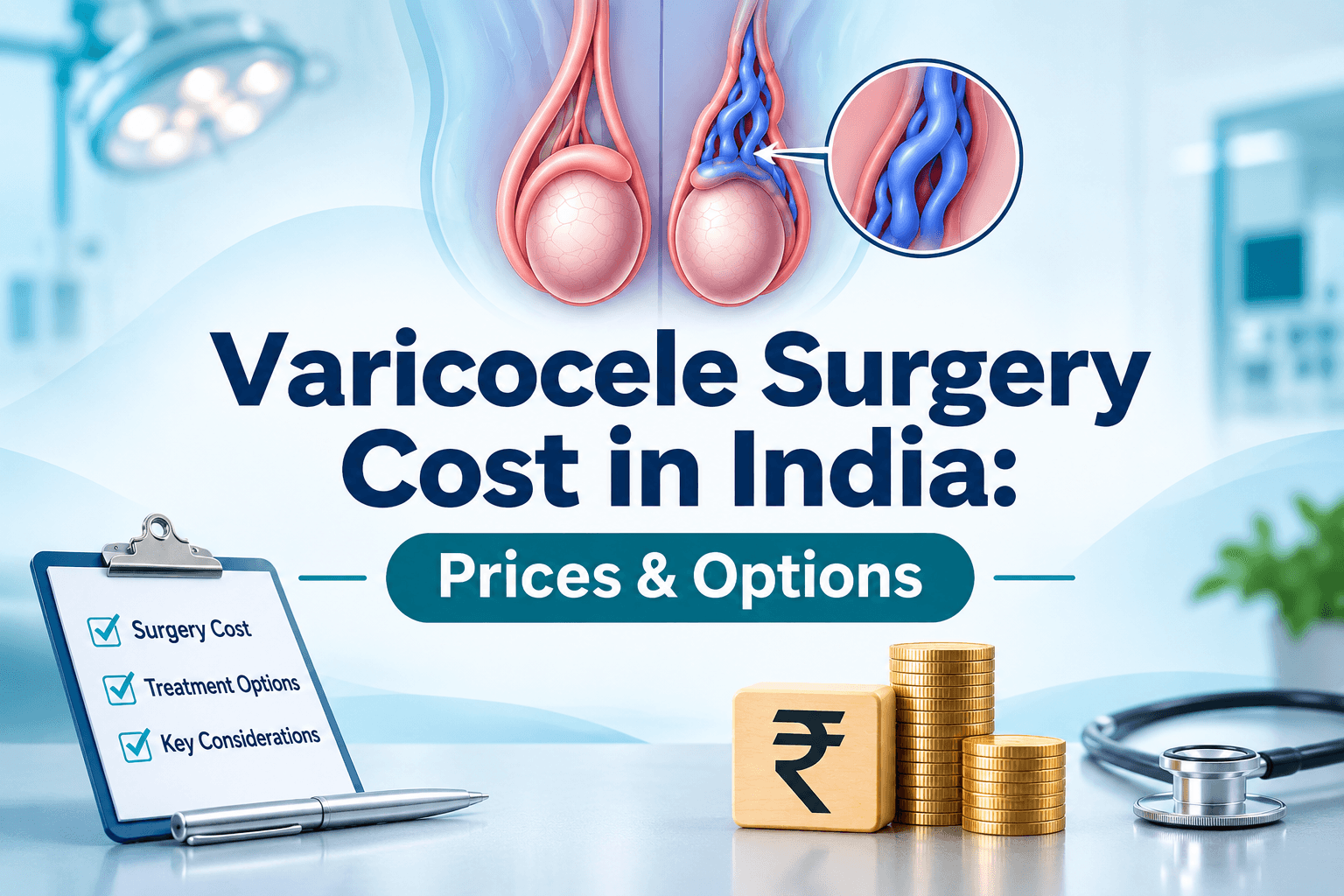
Varicocele Surgery Cost in India: Treatment Options & Cost Factors
A varicocele is a swelling of the veins inside the scrotum, like varicose veins in the leg. It is common, and many men never need an operation. Still, once surgery is mentioned, the first question is usually money. Varicocele surgery cost in India depends on the technique, the hospital, whether one or both sides are treated, what the package includes, and whether surgery is needed at all.
About this article. Written by Aarogyam Surgicare Editorial Team. Last researched 2 November 2026.
Not yet reviewed by a doctor. It draws on published guidelines and peer-reviewed research, but no urologist has checked it. It is not medical advice; confirm anything affecting your care with a doctor.
Method: Clinical statements come from AUA/ASRM, EAU and ASRM guidance, a Cochrane review and meta-analyses; prices from hospital and platform pages re-checked on the research date. Where sources disagree, we say so.
Who we are: Aarogyam Surgicare is a healthcare coordination platform associated with hospitals and doctors; treatment decisions rest with your doctor and the treating hospital. Spotted an error? Use the contact page.
Quick overview: Published estimates vary widely and are not confirmed quotations. One hospital group (Yashoda, Hyderabad) lists open repair at ₹30,000–₹80,000, microsurgical ₹40,000–₹1,80,000, laparoscopic ₹35,000–₹2,00,000 and embolization ₹60,000–₹1,60,000. A listing platform (Lybrate) shows narrower surgical ranges and a higher starting price for embolization. None is a national average; see the cost section.
What Is Varicocele?
A varicocele is an enlargement of the veins around the spermatic cord (the pampiniform plexus). When their one-way valves fail, blood pools and the veins widen. It is found in roughly 14–20% of adolescents, with similar incidence in adulthood (EAU Paediatric), and is more common among men evaluated for infertility. Most are left-sided, because the left testicular vein joins the left renal vein at a right angle and higher than the right-sided vein (Karger).
Symptoms can include a dull, dragging ache or heaviness (often worse after standing), enlarged veins you can feel or see, or a smaller testicle. Many men have none.
Diagnosis. A urologist examines you standing and during a Valsalva manoeuvre (bearing down). Dubin–Amelar grading calls a varicocele subclinical (found only on ultrasound), grade 1 (palpable only with Valsalva), grade 2 (palpable standing) or grade 3 (visible through the skin) (Urology News). The EAU says diagnosis is by examination, with Doppler ultrasound indicated when the examination is inconclusive or to find a persistent or recurrent varicocele after repair (EAU 2026). The clinical versus subclinical distinction matters because guidelines treat them differently, and an ultrasound finding alone does not mean surgery is needed.
First visit. Expect a history and examination. If you are trying to conceive, bring semen reports and your partner's fertility results; the AUA/ASRM guideline advises assessing both partners together (AUA/ASRM). Ask whether treatment is needed at all, which options suit you and their costs.
When Is Surgery Recommended?
Decisions depend on examination, symptoms, fertility goals and tests, and specialists do not agree on every point (WJMH 2022).
Infertility. The AUA/ASRM guideline (2020–21, amended 2024) says varicocelectomy should be considered in men trying to conceive with palpable varicocele(s), infertility and abnormal semen parameters, except azoospermic men (AUA/ASRM). The EAU's 2026 guideline strongly recommends treating infertile men with a clinical varicocele, abnormal semen and otherwise unexplained infertility when the female partner has good ovarian reserve (EAU 2026). These apply to selected men and do not guarantee pregnancy.
Pain. The ASRM says treatment should be considered for pain, or for infertility with abnormal semen (ASRM). Evidence is weaker, and urologists are cautious when pain is the only reason (TAU). Exclude other causes of scrotal pain first.
Adolescents. The EAU Paediatric guideline treats a testis smaller by more than 2 mL or 20% as hypotrophic and recommends offering surgery for a persistently small testis. Treatment can also be considered for symptomatic or bilateral palpable varicocele, abnormal semen in older adolescents, or cosmetic reasons related to scrotal swelling; long-term fertility outcomes remain unknown (EAU Paediatric). The EAU also warns of over-treatment, since most boys will have no fertility problems later (EAU 2026). Adult criteria should not be applied to teenagers.
Surgery may not be needed with a normal semen analysis or a subclinical varicocele (ASRM; EAU 2026). The AUA/ASRM guideline strongly recommends against varicocelectomy for non-palpable varicoceles detected solely by imaging (AUA/ASRM).
Varicocele Surgery Cost in India
There is no fixed price. These are published estimates from one hospital group and one listing platform, not confirmed quotations, and may not match a hospital's current price. We reviewed them on 2 November 2026, flag where a source omits the technique, side or inclusions, and did not average figures or fill gaps ourselves.
| Treatment | Yashoda (Hyderabad) | Lybrate |
|---|---|---|
| Open | ₹30,000 – ₹80,000 | ₹30,000 – ₹40,000 |
| Microsurgical | ₹40,000 – ₹1,80,000 | ₹40,000 – ₹70,000 |
| Laparoscopic | ₹35,000 – ₹2,00,000 | ₹35,000 – ₹65,000 |
| Embolization | ₹60,000 – ₹1,60,000 | ₹90,000 – ₹1,60,000 |
| Robotic-assisted | ₹1,50,000 – ₹2,50,000 | Not listed |
Notes: Lybrate calls microsurgical repair "microscopic". Embolization is a radiology procedure, not surgery. Anaesthesia and hospital type likely affect laparoscopic quotes. Only one source lists robotic-assisted repair; comparable pricing data was not found.
Sources: Yashoda (Hyderabad hospital group; page modified 26 May 2026) and Lybrate (listing platform; undated). Both call their figures approximate.
How to read these figures
- Source types differ and are inconsistent. Yashoda is one hospital group; Lybrate, HexaHealth and Practo are listing platforms with unclear methods and dates. Lybrate's overall range (₹40,000–₹80,000) does not match its own table, and Yashoda's separate Hyderabad microsurgical page lists ₹30,000–₹1,00,000 (Yashoda).
- Overall-only pages. CARE (₹35,000–₹1,20,000; undated), Medicover (₹25,000–₹85,000) and HexaHealth (₹23,000–₹70,000, sourced from patients and partners) give no technique-wise prices.
- Sides and inclusions are unclear. No headline figure says whether it covers one side or both, or includes tests, anaesthesia, medicines and follow-up. Assume extras until confirmed in writing.
- Do not average them: they differ in source, technique, city and date.
Many conventional procedures are quoted from a few tens of thousands of rupees to around ₹1 lakh; microsurgical, laparoscopic and embolization quotes can run higher. These are not upper limits. Treat this as rough orientation and rely on a written quotation after clinical evaluation.
Treatment Types and Costs
When treatment is recommended, the main options are surgical repair and radiological embolization (EAU 2026). Some patients need no intervention and can be monitored by their urologist.
| Technique | What it involves | Why cost may differ |
|---|---|---|
| Open | Cut in the groin or lower abdomen; veins tied off | Generally lower; no magnification |
| Microsurgical | Small cut at or below the groin; operating microscope helps spare the testicular artery and lymphatics | Microscope, specialised training |
| Laparoscopic | Small abdominal cuts, camera, thin instruments; usually general anaesthesia | Theatre and anaesthesia charges |
| Embolization | Radiologist blocks the testicular vein through a catheter; often sedation or local anaesthesia | Imaging equipment, radiology team |
Evidence. These comparisons come from studies of varying quality and are not a ranking for every patient. A Cochrane review in subfertile men found microscopic subinguinal repair probably improves pregnancy rates slightly versus other surgical techniques (moderate-certainty, 12 randomised trials), and could not say whether surgery or radiological treatment is superior (Cochrane). A 2024 meta-analysis of randomised trials found higher recurrence and hydrocele risk after laparoscopic than microsurgical repair, with no significant difference in spontaneous pregnancy (Warli 2024). A 2015 network meta-analysis found lower recurrence with microsurgery than retroperitoneal open surgery (Wang 2015). Surgeon skill and patient selection still matter, microsurgery is not available everywhere, and nothing here guarantees an outcome.
Embolization is not conventional surgery. A 2022 meta-analysis found similar recurrence and pregnancy rates to surgery with fewer adverse events (JVIR); a Canadian series reported higher technical failure in attempted bilateral embolization (CUAJ).
Factors That Affect Cost
- Technique and surgeon. Open repair is generally quoted lower, but ranges overlap widely. Microsurgery depends on training, though a higher fee does not by itself mean a better result.
- One side or both. Medicover says treating both sides increases the cost. Practo's Delhi page lists unilateral at about ₹52,500 and bilateral at ₹63,000–₹84,000, with the same pattern for Mumbai, Bangalore, Hyderabad and Pune (Practo): roughly 1.2–1.6 times, not double. The identical ratio everywhere suggests modelled estimates, so treat it as a rough guide.
- Hospital and facilities. HexaHealth (undated, unverified) shows averages of ₹60,000 for super-speciality hospitals and ₹41,500 for multi-speciality. Category describes size and facilities, not clinical quality, and not every hospital offers every technique.
- Tests. Lybrate estimates pre-operative blood and urine tests at ₹2,150–₹5,500; Practo lists ₹3,500–₹5,000 for a blood test and colour Doppler. They count different tests.
- Anaesthesia, stay, follow-up. Yashoda says most patients go home the same day; Lybrate mentions one to two days. Some packages include set reviews; others charge per visit.
Package and Written Estimate
Hospitals usually confirm costs only after a doctor's consultation (Yashoda), so ask for an itemised written estimate at or after that visit. It should state:
| Component | What to confirm |
|---|---|
| Consultation | Included or separate? |
| Investigations | Which tests are included, which are not? |
| Procedure and side | Exact technique; one side or both? |
| Surgeon and anaesthetist | Included, shown separately or together? |
| Theatre and consumables | Included? |
| Room and stay | Category; day care or overnight; how many days? |
| Medicines and dressings | Included? |
| Follow-up | How many visits, until when? |
| Extras | What is billed separately, how extra charges are approved, how long the estimate is valid |
Extras can include more tests, a longer stay, treating complications, and travel; we give no amounts because we found no reliable figures.
Cost by City
A city table would be easy to build, but listing-site figures do not share a basis, rarely state the side treated, and are mostly undated. Practo's table labelled "Open Surgery (Microsurgical varicocelectomy)" lists Kanpur at ₹55,000–₹60,000, identical to ten other cities including Ahmedabad, Indore and Nagpur, yet ₹61,000–₹1,03,000 for Delhi (Practo). Lybrate lists an identical ₹40,000–₹80,000 for ten cities including Lucknow (Lybrate). Neither is the price in your city.
If you are searching for varicocele surgery cost in Lucknow, Delhi or another city, the reliable answer comes from the treating hospital after a consultation: ask two or three for itemised estimates for the same procedure. Aarogyam Surgicare lists associated hospitals in Lucknow, Delhi, Gurgaon, Mumbai, Pune, Bangalore, Hyderabad, Indore and Kochi on its hospitals page; procedure availability depends on the hospital, so ask when you request a callback.
Recovery
Recovery varies by technique, health and surgeon. These examples come largely from outside India; read them as general illustrations.
- First 24–48 hours: Many go home the same day or after a short stay. Mild pain, swelling and bruising are common.
- First one to two weeks: Kaiser Permanente says many return to work in two to three days and avoid intense activity for two to three weeks or until cleared (Kaiser). Yashoda states two to six weeks for full recovery.
- Follow-up: If fertility was the reason, a repeat semen analysis is usually planned after a few months, because semen parameters can take months to change (EAU 2026).
Risks
Repair is generally considered safe, but no procedure is risk-free. Possible issues include pain, bruising or swelling; infection; hydrocele (fluid around the testicle; see Aarogyam's hydrocele guide); recurrence; rare injury to the testicular artery or lymphatics; anaesthesia risks; and, with embolization, vein injury or incomplete blockage. Pooled analyses generally show lower hydrocele and recurrence with microsurgery, though data are not uniform (Warli 2024, Wang 2015). After surgery, contact your surgeon promptly for fever, spreading redness, increasing pain or rapid swelling.
When to Seek Prompt Assessment
Most varicoceles are not emergencies, but some symptoms point elsewhere:
- Sudden, severe testicular pain, especially with nausea, vomiting or abdominal pain, is not typical of a varicocele and can signal testicular torsion. Go to the nearest emergency department immediately (NHS).
- Rapid swelling, redness or fever in the scrotum, or a noticeable size difference between the testicles (especially in a teenager).
- A right-sided varicocele, or one that is new, large or painful. The EAU says an isolated clinical right-sided varicocele should be examined further for abdominal, retroperitoneal or congenital causes (EAU 2026). The AUA no longer requires routine abdominal imaging for it but still advises it when it is new, large or symptomatic and does not reduce when lying down (AUA News).
- Difficulty conceiving. After 12 months of trying, both partners should generally be evaluated; after 6 months if the female partner is 35 or older, and earlier with known fertility concerns or risk factors (ASRM).
Fertility
For selected men, surgery may help. The AUA/ASRM guideline cites a meta-analysis reporting higher pregnancy rates after repair of a clinical varicocele than with no treatment, and no demonstrable benefit for subclinical varicocele (AUA/ASRM). The limits matter:
- Selection. Benefit applies to men with a palpable varicocele, abnormal semen and infertility, not every man with a varicocele. Results vary, and nothing can be promised.
- Azoospermia. For men with no sperm in the semen, the AUA/ASRM guideline says couples should be told there is no definitive evidence supporting repair before assisted reproduction. A 2026 EAU panel commentary sees some evidence of benefit but not enough for a strong recommendation (Boeri 2026).
- Time. Semen parameters can take up to two spermatogenic cycles to improve, with pregnancy typically six to twelve months after repair (EAU 2026). Repair can also delay other fertility treatment, and the female partner's fertility needs assessment too.
Insurance
Sometimes, but there is no general answer. Cover depends on your policy wording, the medical reason and the insurer's decision. We found no source stating a rule for varicocele surgery, so treat this as a checklist.
- Reason for treatment. Some insurers list "Sterility and Infertility" as an exclusion; one insurer's 2026 information sheet is an example (IFFCO-Tokio), and wording differs by insurer. Surgery for fertility may be examined under such a clause; surgery for another reason, such as persistent pain, may be assessed differently. The insurer decides from your policy and records.
- Waiting periods and day-care lists. Policies commonly apply waits for specified procedures, and each insurer publishes its own day-care list (Niva Bupa).
- Pre-authorisation. For cashless treatment, ask the hospital's insurance desk to request it in writing before the procedure is scheduled. Commonly requested: the pre-authorisation form, health card, photo ID, and your doctor's note recommending the procedure with diagnostic reports; the list varies (Zurich Kotak, Manipal Cigna).
Keep three questions separate: does your policy cover the procedure, is cashless available at this hospital, and will the insurer approve this claim? A yes to one is not a yes to the others. Aarogyam Surgicare's insurance support page describes how its team coordinates pre-authorisation and paperwork, and states that it does not guarantee approval.
Comparing Quotes
Quotes are comparable only when they describe the same procedure with the same inclusions. Beyond the written estimate, check the care behind it:
- The urologist: urology qualifications and how often they perform the proposed technique.
- Equipment and follow-up: microsurgery needs a surgical microscope, embolization an interventional radiology unit; ask how complications would be handled and billed.
A hospital's category is not a measure of clinical quality, and this guide does not rank hospitals.
A worked example (hypothetical, no real hospital or prices):
| Cost component | Hospital A | Hospital B |
|---|---|---|
| Procedure fee | Lower | Higher |
| Diagnostic tests | Extra | Included |
| Anaesthesia | Extra | Included |
| Medicines | Extra | Partly included |
| Follow-up | Extra | Included |
| Final payable amount | Add every line | Add every line |
Hospital A's lower headline fee may look cheaper, but with extras its total can match or exceed Hospital B's. Compare totals, not surgery fees. For a similar breakdown, see Aarogyam's hernia surgery cost guide.
Questions for your urologist: What is the grade and significance of my varicocele? Is treatment needed, or is monitoring enough? Why this procedure, and what are the alternatives? What does the quote include? What are the risks, recovery and follow-up?
FAQs
1. How much does varicocele surgery cost in India? The sources reviewed list estimates from around ₹23,000 to ₹2,50,000, depending on the technique. The upper figure is from one provider (robotic-assisted repair) and is not a national benchmark; conventional procedures are generally quoted lower. Get a written quote.
2. What do microsurgical and laparoscopic repair cost? Yashoda lists ₹40,000–₹1,80,000 (microsurgical) and ₹35,000–₹2,00,000 (laparoscopic); Lybrate lists ₹40,000–₹70,000 and ₹35,000–₹65,000. Neither says whether prices are per side, and neither technique is available everywhere.
3. Does bilateral surgery cost more? Usually, but not necessarily double; Practo's estimates put it at roughly 1.2–1.6 times the one-sided figure. Ask for both amounts in writing.
4. Is embolization cheaper than surgery? Not necessarily. It is listed at ₹60,000–₹1,60,000 (Yashoda) and ₹90,000–₹1,60,000 (Lybrate), often at or above open surgery.
5. Does insurance cover varicocele surgery? It depends on your policy, the medical reason and the insurer. Some exclude infertility-related expenses, and waiting periods may apply. Get written pre-authorisation first.
6. How long is recovery? Many return to light activity within a few days, but timelines vary; strenuous exercise is commonly avoided for two to three weeks. Follow your surgeon.
7. Is surgery necessary for every patient? No. Guidelines support repair in specific situations, such as a palpable varicocele with infertility and abnormal semen, and advise against it for varicoceles found only on imaging.
8. Is it a day-care procedure? Often, but it depends on technique, patient and hospital. Yashoda says most patients go home the same day; Lybrate mentions one to two days.
9. When should semen analysis be repeated? Your specialist decides, usually after a few months; the EAU says semen parameters can take up to two spermatogenic cycles to improve.
Conclusion
Varicocele surgery cost in India does not come down to one number: it varies with the technique, sides treated, hospital, surgeon and package, so a written quotation is the only reliable guide. A low quote is not necessarily the best option, and not every varicocele needs surgery. Ask a qualified urologist first, then compare like-for-like quotes and check your insurance.
Not sure which option is appropriate? Discuss your diagnosis with a qualified urologist. Aarogyam Surgicare (urology section) is a healthcare coordination platform associated with hospitals and doctors, and can help with the next step:
- Request a callback on the contact page: say which treatment you are asking about, your city, your insurer (optional) and whether you prefer a clinic visit, video call or phone call.
- Speak to the care team, which helps coordinate a consultation through its associated hospitals, subject to availability.
- Get a doctor's assessment. A qualified doctor at the treating hospital explains options and estimated costs. Rely on the hospital's written estimate; the team can help you obtain an itemised one.
- Insurance. If you plan to claim, the team can help coordinate pre-authorisation and paperwork but does not guarantee approval.
Treatment decisions rest with your doctor and the treating hospital, and which procedures are available depends on the hospital.
Medical disclaimer: This article is for general education only. It has not yet been reviewed by a doctor or other medical professional, does not replace consultation with a qualified healthcare professional, and is not a diagnosis or treatment recommendation. Cost figures are indicative and may change; confirm prices with the hospital in writing and verify insurance cover with your insurer.
References
- AUA/ASRM Guideline Part II, 2021: ASRM. Amended 2024 (Brannigan RE, et al. J Urol 2024;212(6):789–799, DOI); statements cited are from the 2021 text. AUA page.
- EAU Guidelines: Sexual and Reproductive Health 2026, Male Infertility §11.4.3; Paediatric Urology, Varicocele.
- ASRM fact sheets: Varicocele; Infertility, rev. 2023.
- Evidence: Cochrane CD000479; Warli SM, et al. Urol Ann 2024;16(2):113–119, DOI; Wang J, et al. Asian J Androl 2015, DOI; J Vasc Interv Radiol 2022;33(7):834–840; Cassidy D, et al. CUAJ; Boeri L, et al. Eur Urol 2026;89(5):391–393, DOI.
- Background: World J Mens Health 2022; Transl Androl Urol review; Urology News; Urol Int review; AUA News 2021; NHS; Kaiser Permanente.
- Cost pages (accessed 2 Nov 2026): Yashoda (modified 26 May 2026; also microsurgical page); undated: Lybrate, CARE, Medicover, HexaHealth, Practo (India, Delhi).
- Insurance: IFFCO-Tokio sheet, 2026 (one insurer's wording, as an example); Niva Bupa; Zurich Kotak; Manipal Cigna.