
Laser Piles Surgery Recovery Time, Side Effects & Disadvantages
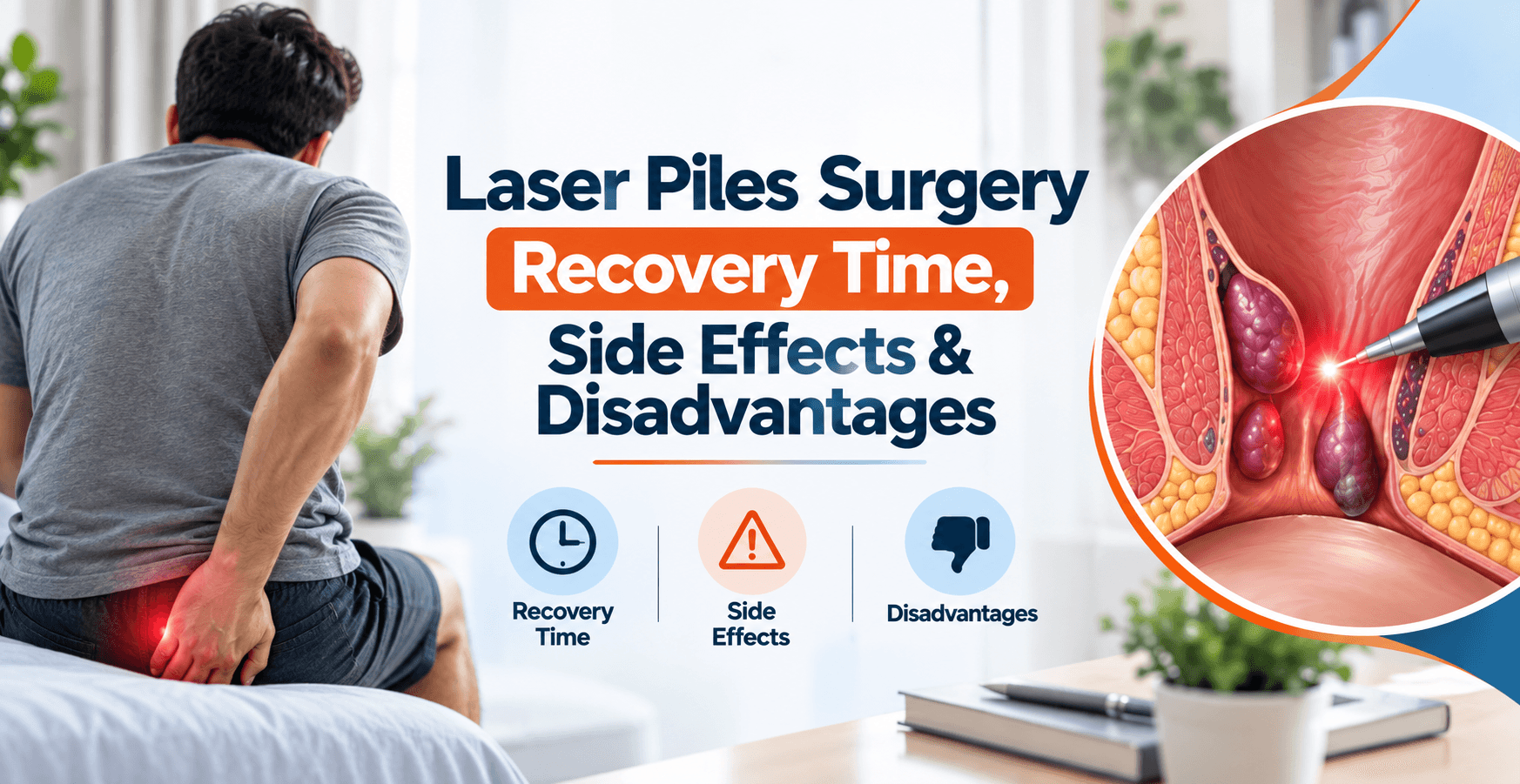
Most people booked in for laser piles surgery want to know one thing above all: how long before life goes back to normal. How many days off work, when sitting stops being unpleasant, when the gym is realistic again.
The answers are less tidy than the marketing suggests. Research comparing laser hemorrhoidoplasty with conventional surgery does point to advantages in the early period — less pain in the first days, and a quicker return to activity in several studies. But an average from a trial is not a promise for one person, short-term results say little about the years afterwards, and "laser" does not mean the recovery is effortless.
What follows is a realistic account of recovery after laser piles surgery, along with the side effects that can occur, the limitations of the procedure, and the symptoms that mean you should call the hospital rather than wait.
How Long Does Laser Piles Surgery Take to Recover?
Recovery varies, and honest sources say so rather than quoting a fixed number of days.
What the evidence does support is a pattern. Meta-analyses comparing laser hemorrhoidoplasty with conventional excisional hemorrhoidectomy have found lower pain scores in the early days after surgery, lower use of pain medication, and earlier return to work or daily activities in the laser group. One meta-analysis reported a mean difference of about 2.5 points on the day-one pain score in favour of laser hemorrhoidoplasty.
Those findings describe averages across groups of patients with particular grades of hemorrhoidal disease, compared against a specific alternative operation. They are a reasonable basis for expecting a gentler early recovery than after a conventional excision — not a schedule you can hold your surgeon to. Grade of disease, how much was treated, and individual healing all move the timeline.
What Is Laser Piles Surgery?
Piles (hemorrhoids) are swollen, inflamed veins in the anal canal and lower rectum. When they need surgical treatment, there is more than one way to go about it.
Laser hemorrhoidoplasty is the procedure most often meant by "laser piles surgery" in the medical literature. A laser fibre delivers energy into the hemorrhoidal tissue, with the aim of shrinking it, rather than cutting the hemorrhoid away. A conventional excisional hemorrhoidectomy — the Milligan-Morgan or Ferguson operation — removes the hemorrhoidal tissue and leaves wounds that heal over a period of weeks.
That difference in approach is why the early recovery tends to differ. It is also worth knowing that not every clinic means exactly the same thing by "laser treatment for piles", and settings and technique vary. Asking which specific procedure is planned is more useful than asking whether a hospital offers laser.
Who May Be Considered for Laser Treatment?
Selection depends on the type of hemorrhoids, their grade, whether there is prolapse, the symptoms causing trouble, what has already been tried, and the surgeon's examination findings.
Much of the comparative research on laser hemorrhoidoplasty has been carried out in patients with particular grades of hemorrhoidal disease — grade II and III feature prominently in the published comparisons. Evidence generated in those groups does not automatically transfer to advanced grade IV disease with significant prolapse, where a different operation may be more appropriate.
No article can tell you whether you are a suitable candidate. That requires an examination.
What to Expect Immediately After Laser Piles Surgery
It helps to separate three different things: what is expected, what is a possible complication, and what needs urgent attention.
Commonly expected in the early period — soreness or discomfort around the anus, some swelling, discomfort with the first bowel movements, and a degree of anxiety about passing stool. Minor spotting of blood can occur.
Possible complications — bleeding beyond minor spotting, infection, difficulty passing urine, thrombosis, persistent symptoms, or symptoms returning later.
Needs prompt medical attention — heavy or continuing bleeding, severe or worsening pain, fever, increasing swelling, pus or foul discharge, or inability to pass urine.
Calling something "normal" when it is not is how problems get ignored. If you are unsure which category a symptom falls into, that itself is a reason to phone the hospital.
Is Pain Normal After Laser Piles Surgery?
Some discomfort is expected. Anyone telling you the procedure is painless is overselling it.
The evidence on pain is genuinely encouraging in one specific comparison. Meta-analyses of laser hemorrhoidoplasty against conventional excisional hemorrhoidectomy have reported lower pain scores on the first day after surgery, lower analgesic requirements, and lower pain over the following week and month. One analysis described a mean difference of around 4.88 mg of morphine and 2.25 days in the duration of post-operative pain relief needed.
Read that carefully, though. It says laser hemorrhoidoplasty hurt less on average than a specific alternative operation. It does not say there is no pain, and it does not describe what any individual will feel. Pain varies with the grade of disease, how much tissue was treated, technique and individual sensitivity.
Pain relief is arranged by the treating team. Pain that intensifies instead of settling, or that comes with fever or swelling, should be reported rather than tolerated.
Is Bleeding Normal After Laser Piles Surgery?
A small amount of bleeding or spotting can occur in the early period, particularly with bowel movements.
Comparative studies have reported less operative blood loss and lower rates of post-operative bleeding with laser hemorrhoidoplasty than with conventional hemorrhoidectomy. Lower is not zero, and it does not mean bleeding should be dismissed.
Heavy bleeding, bleeding that continues rather than settling, blood clots, or bleeding accompanied by dizziness or weakness needs urgent assessment. It is not sensible to try to judge an acceptable volume at home — if the bleeding worries you, that is reason enough to contact the hospital or attend an emergency department.
Bowel Movements After Laser Piles Surgery
The first bowel movement is the part most people dread, and the anxiety itself can become a problem — people delay going, stool hardens, and the experience becomes worse than it needed to be.
The general principles your team will emphasise are keeping stools soft, avoiding constipation, and not straining. Adequate fibre and fluids support that. Where a stool softener or laxative is appropriate, your surgeon will prescribe it — this is not something to self-medicate, and no dosage advice belongs in an article.
Some discomfort with early bowel movements is common. Increasing pain, significant bleeding, or an inability to pass stool at all are different matters and should be reported.
What to Eat After Laser Piles Surgery
Nothing exotic is required. The aim is simply to keep stools soft so that healing tissue is not repeatedly strained.
In practice that means fibre-rich foods — vegetables, fruit, whole grains, pulses — and enough fluid through the day, unless your doctor has restricted your intake for another reason. Most people return to their usual diet gradually, guided by what they can tolerate and by the instructions they were given.
No particular food speeds up healing, whatever you may read. Claims about miracle diets after piles surgery are not supported, and a sensible high-fibre pattern is what the general advice on hemorrhoidal disease has long emphasised.
When Can You Return to Work?
This depends on how you are healing and what your job asks of you.
Comparative research has reported earlier return to work or daily activities after laser hemorrhoidoplasty than after conventional hemorrhoidectomy. That is a group finding and a relative one — it tells you the direction of travel, not your date.
A desk job with the option to stand and move periodically is a different proposition from work involving heavy lifting, long hours of sitting, or being on your feet all day. Your surgeon's advice, based on what was done and how you are recovering, is the reference that matters.
When Can You Walk and Exercise?
Gentle walking is usually encouraged early, and moving about is generally better than lying still for days.
Returning to structured exercise is a gradual process. Activities that involve heavy lifting, straining, or prolonged pressure on the area are typically the last to come back, and specific restrictions depend on the procedure and your recovery. Ask for guidance for your case rather than following a general timeline found online.
Laser Piles Surgery Recovery Timeline
The table below describes a general pattern rather than a guaranteed schedule. Where published evidence supports a direction — such as lower early pain compared with conventional surgery — that context is noted, but individual recovery varies.
| Stage | What you may experience | What generally helps | When to seek advice |
|---|---|---|---|
| Day of procedure | Soreness, swelling, effects of anaesthesia | Rest, prescribed pain relief, following discharge instructions | Heavy bleeding, inability to pass urine, severe pain |
| First few days | Discomfort, anxiety about the first bowel movement, minor spotting | Soft stools, adequate fluids, avoiding straining, gentle movement | Worsening pain, fever, significant bleeding |
| First week | Gradual settling of discomfort; bowel movements becoming easier | Fibre in the diet, short walks, prescribed medication as directed | Pain increasing rather than easing, pus or foul discharge |
| Following weeks | Return towards routine; some symptoms may take longer to settle | Maintaining bowel habits, gradual return to activity | Symptoms not improving as expected, recurrent bleeding |
| Return to routine | Work and exercise resumed in stages | Following surgeon's guidance on lifting and exercise | Symptoms returning after initial improvement |
| Follow-up | Review of healing and symptoms | Attending the appointment; reporting anything unresolved | Any concern between appointments |
Laser Piles Surgery Side Effects
Beyond the expected soreness and minor bleeding already described, the possibilities worth being aware of include infection, difficulty passing urine or urinary retention, thrombosis in the area, persistent symptoms where the treatment does not fully resolve the problem, and recurrence at a later stage. Some patients need a further procedure.
These are possibilities, not predictions, and they are not equally likely. Reliable complication rates specific to laser hemorrhoidoplasty vary between studies, so quoting a single percentage would misrepresent the evidence. What the comparative research does suggest is lower rates of some complications than conventional hemorrhoidectomy — post-operative bleeding and anal stenosis among them — which is part of the procedure's appeal.
What Are the Disadvantages of Laser Piles Surgery?
A balanced view has to include the limitations, and there are real ones.
It is not suitable for everyone. Much of the supporting comparative evidence comes from selected grades of hemorrhoidal disease. Advanced prolapsing disease may be better addressed by a different operation.
Long-term durability is less certain than short-term comfort. This is the most important caveat. While several analyses found no significant difference in recurrence between laser hemorrhoidoplasty and conventional hemorrhoidectomy, and 12-month recurrence has been reported as similar, one study with a mean follow-up of about 25 months reported symptom recurrence in 8.1% after Milligan-Morgan hemorrhoidectomy versus 21.6% after laser hemorrhoidoplasty. Findings differ, follow-up periods differ, and the question is not settled.
Technique is not standardised. Different centres use different equipment and settings, so results reported for one protocol may not transfer to another.
A second procedure may be needed if symptoms persist or return.
Availability and surgeon experience vary, and the equipment involved adds cost.
None of this makes laser treatment a poor choice. It makes it a choice with trade-offs — better early comfort in the published comparisons, against less certainty about how it performs over years.
Laser Piles Surgery vs Conventional Hemorrhoidectomy
| Aspect | Laser hemorrhoidoplasty | Conventional excisional hemorrhoidectomy |
|---|---|---|
| Approach | Laser energy applied to shrink hemorrhoidal tissue | Hemorrhoidal tissue surgically removed |
| Early pain | Lower pain scores reported in meta-analyses of the two | Higher early pain reported in the same comparisons |
| Pain medication | Lower requirement reported | Higher requirement reported |
| Bleeding | Less operative blood loss and lower post-operative bleeding reported | Higher in the reported comparisons |
| Return to activity | Earlier return reported in several studies | Generally later in the same comparisons |
| Anal stenosis | Lower rates reported | Higher rates reported |
| Recurrence | Findings conflict — similar in several analyses, higher in at least one longer-term study | Long-established procedure with longer follow-up data |
| Suitability | Evidence concentrated in selected grades | Used across a broader range, including advanced disease |
The fair summary is that laser hemorrhoidoplasty may offer meaningful short-term recovery advantages in selected patients, while the appropriate procedure still depends on the grade and nature of the hemorrhoidal disease — and the long-term evidence deserves to be read carefully rather than assumed.
Can Piles Come Back After Laser Surgery?
Yes, recurrence is possible. It is possible after conventional surgery too.
As noted above, the published findings do not agree. Several analyses found recurrence broadly similar between the two approaches, including at 12 months; a study with longer follow-up reported a higher rate after laser hemorrhoidoplasty. Because these studies differ in design, patient grade and follow-up length, no single recurrence figure can be presented as what you should expect.
What is reasonable to say: the factors that contributed to hemorrhoidal disease in the first place — constipation, straining, prolonged sitting on the toilet — do not disappear because an operation has been done. Bowel habits remain relevant afterwards.
Does Laser Piles Surgery Cure Piles Permanently?
No responsible answer promises a permanent cure.
The procedure aims to treat the hemorrhoidal disease that is causing symptoms, and many patients get lasting relief. But symptoms can recur, the long-term comparative evidence is mixed, and the conditions that led to the problem may persist. Anyone offering a guarantee of permanent cure is making a claim the evidence does not support.
When Should You Contact Your Doctor?
Get in touch with your surgical team, or seek urgent care, if you have:
- Heavy bleeding, or bleeding that continues rather than settling
- Severe pain, or pain that worsens instead of easing
- Fever
- Increasing swelling around the area
- Pus or foul-smelling discharge
- Difficulty passing urine, or inability to pass urine
- Symptoms that are not improving in the way you were told to expect
- Symptoms that return after an initial improvement
Most people recover without any of this. The reason for listing it is so that you recognise a problem early, not so that you spend the first week worrying.
Follow-Up After Laser Piles Surgery
Follow-up is where healing is checked, lingering symptoms are assessed, and bowel habits are reviewed — the last of these matters more than patients often expect, since constipation and straining remain relevant to long-term results.
It is also the appointment at which persistent or returning symptoms should be raised. Schedules vary between surgeons and procedures, so attend the appointments you are given rather than assuming that feeling well means follow-up is unnecessary.
Questions to Ask Before Choosing Laser Piles Surgery
- What type and grade of hemorrhoids do I have?
- Why are you recommending laser treatment in my case?
- Which exact laser procedure is being proposed?
- Is the evidence for this procedure relevant to my grade of disease?
- What recovery should I realistically expect?
- When could I return to my job, given what it involves?
- When can I resume exercise and lifting?
- Which symptoms are expected afterwards, and which should make me call?
- What alternatives would be reasonable for me?
- What are the chances of symptoms returning, and what would happen then?
- How often do you perform this procedure?
- What follow-up will I have?
Frequently Asked Questions
How long does laser piles surgery take to recover?
Recovery varies with the grade of disease, how much was treated and individual healing, so no fixed period applies to everyone. Comparative studies of laser hemorrhoidoplasty against conventional excisional hemorrhoidectomy have reported lower early pain and earlier return to work or daily activities in the laser group — a useful direction, but a group average rather than a personal timeline.
Is laser piles surgery painful?
Some discomfort should be expected. Meta-analyses comparing laser hemorrhoidoplasty with conventional hemorrhoidectomy have reported lower pain scores on day one and lower use of pain medication afterwards. That is a comparison, not a claim of painlessness. Pain varies between individuals, and pain that worsens rather than settles should be reported to your surgical team.
Is bleeding normal after laser piles surgery?
Minor spotting, particularly with bowel movements, can occur in the early period. Studies have reported less operative blood loss and lower post-operative bleeding than with conventional hemorrhoidectomy — lower, not absent. Heavy bleeding, bleeding that continues rather than settling, clots, or bleeding with dizziness needs urgent assessment rather than judgement at home.
When can I return to work after laser piles surgery?
It depends on how you are healing and what your work involves. Earlier return to work or activities has been reported after laser hemorrhoidoplasty than after conventional surgery, but that is a relative finding across study groups. Desk work and physically demanding work differ considerably, so follow the guidance your surgeon gives for your case.
When can I exercise after laser piles surgery?
Gentle walking is usually encouraged early. Structured exercise comes back gradually, and activities involving heavy lifting, straining or prolonged pressure on the area are typically resumed last. Specific restrictions depend on what was done and how recovery is progressing, so ask for advice for your procedure rather than following a general online timeline.
What should I eat after laser piles surgery?
The aim is soft stools so healing tissue is not repeatedly strained. That means fibre-rich foods such as vegetables, fruit, whole grains and pulses, with adequate fluids unless your doctor has restricted them. Most people return to their usual diet gradually. No particular food is proven to speed healing, despite what some sources claim.
What are the disadvantages of laser piles surgery?
It is not suitable for every patient — much of the supporting evidence comes from selected grades of hemorrhoidal disease. Technique is not standardised between centres, a further procedure may be needed if symptoms persist, and long-term durability is less certain than early comfort. Findings on recurrence compared with conventional surgery conflict between studies.
Can piles come back after laser surgery?
Yes. Published findings differ: several analyses reported recurrence broadly similar to conventional hemorrhoidectomy, including at 12 months, while a study with about 25 months' follow-up reported 8.1% after Milligan-Morgan versus 21.6% after laser hemorrhoidoplasty. Study designs and follow-up periods vary, so no single figure applies. Bowel habits remain relevant afterwards.
Is laser piles surgery suitable for everyone?
No. Suitability depends on the type and grade of hemorrhoids, the degree of prolapse, symptoms, previous treatment and examination findings. Comparative evidence has concentrated on particular grades, and advanced prolapsing disease may be better treated by a different operation. Only an examination can establish whether it is appropriate for you.
Is laser piles surgery better than conventional surgery?
It appears to offer short-term advantages in the published comparisons — less early pain, less bleeding, earlier return to activity, lower rates of anal stenosis. Long-term recurrence findings conflict. So it may suit some patients well while not being universally superior, and the right operation depends on the grade and nature of the disease.
Conclusion
Recovery after laser piles surgery is generally more comfortable in the early days than after a conventional excisional hemorrhoidectomy, and the published comparisons support that. What they do not support is a fixed recovery timetable, a promise of no pain, or certainty about how the procedure performs over several years. Expect some discomfort, follow the bowel and wound advice you are given, know which symptoms warrant a phone call, and treat any claim of a permanent guaranteed cure with scepticism.
Written by: Aarogyam Surgicare Editorial Team
Disclaimer
Disclaimer: This article is for general health information only and does not replace a medical consultation, examination or individualized medical advice. Recovery after piles surgery varies from person to person, and the appropriate treatment depends on the type and severity of hemorrhoidal disease. Speak with a qualified healthcare professional for advice about your condition.
Sources
- Lie H, et al. — Laser hemorrhoidoplasty versus conventional hemorrhoidectomy for grade II/III hemorrhoids: a systematic review and meta-analysis — pubmed.ncbi.nlm.nih.gov
- Diode laser hemorrhoidoplasty versus conventional Milligan-Morgan and Ferguson hemorrhoidectomy for symptomatic hemorrhoids: meta-analysis — pubmed.ncbi.nlm.nih.gov
- Systematic review and meta-analysis of postoperative pain and symptom control following laser haemorrhoidoplasty versus Milligan-Morgan haemorrhoidectomy — pmc.ncbi.nlm.nih.gov
- Mid-term efficacy and postoperative wound management of laser hemorrhoidoplasty vs conventional excisional hemorrhoidectomy in grade III hemorrhoidal disease — pmc.ncbi.nlm.nih.gov
- National Institute of Diabetes and Digestive and Kidney Diseases (NIDDK) — Hemorrhoids — niddk.nih.gov
- NHS — Piles (haemorrhoids) — nhs.uk